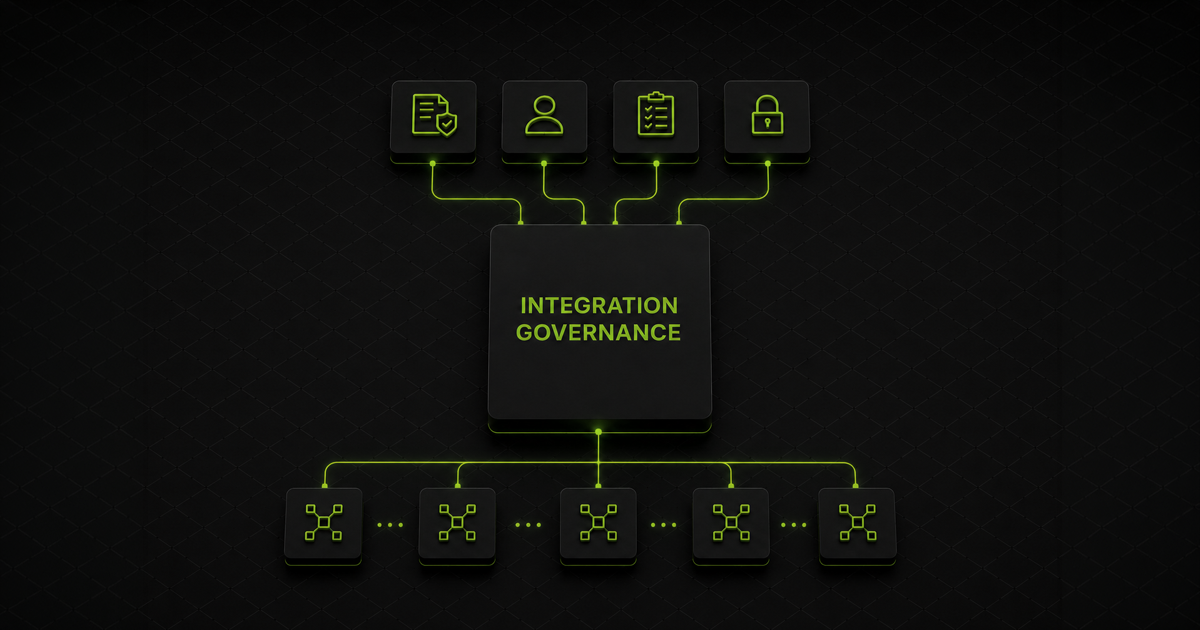


Integration governance is the framework of policies, roles, standards, and controls that keeps a growing estate of enterprise integrations secure, accountable, and maintainable as it scales.
Where a single system integration can live in one engineer's head, an estate of dozens or hundreds cannot — and without governance, it degrades into an undocumented, unowned, unauditable liability. A governance framework prevents that by defining who can build integrations, how they must be built, who owns them, what data they're allowed to move, and how changes are controlled.
This guide lays out a practical integration governance framework: the policies, the roles and responsibilities, the controls, and the operating model that makes governance work at scale rather than as paperwork.
Key takeaways
- Integration governance has four pillars: an integration inventory (knowing what you have), clear ownership (knowing who's accountable), standards (knowing the rules), and controls (knowing what's enforced).
- Governance is cheap to establish early and expensive to retrofit. The cost rises sharply once an estate is already large and undocumented.
- Governance enables citizen integration rather than restricting it — guardrails are what make distributed building survivable.
- Effective governance is operational, not bureaucratic. It lives in monitoring, ownership, and build-time controls, not in a static policy document.
- The Integration Ops model treats governance as a continuous operating capability, the same way DevOps embedded governance into the delivery pipeline.
What is integration governance?
Integration governance is the set of policies, standards, roles, and controls that ensure an organization's integrations are built consistently, owned clearly, secured properly, and maintained reliably across their lifecycle. It answers five questions for every integration in the estate: What does it do? Who owns it? How was it built? What data does it touch? Who can change it?
Governance is distinct from the act of building integrations. You can build a single integration with no governance at all and it will work fine. The need for governance emerges with scale — when the number of integrations exceeds what any individual can track, and when integrations cross security, compliance, and organizational boundaries. (This is a core theme in ONEiO’s integration architecture guide: at scale, how data flows and who governs it matters more than any single connection.)
Why integration governance matters at scale
A small number of system integrations is self-governing. The engineer who built them knows them, maintains them, and fixes them. The trouble begins as the estate grows.
Past a few dozen integrations, several failures appear at once: no one has a complete inventory; integrations built by people who've since left go unmaintained; security and compliance teams can't answer where customer data flows; and changes to one system break integrations nobody remembered existed. Each of these is a governance gap, and each becomes more expensive the longer it's ignored.
The economics are unforgiving: governance is inexpensive to establish when the estate is small and brutally expensive to retrofit once it's large and undocumented. Mature integration teams therefore establish governance before the pain is obvious — which is also when it feels premature. (For how this ties to cost, see how to calculate and control the cost of service integrations.)
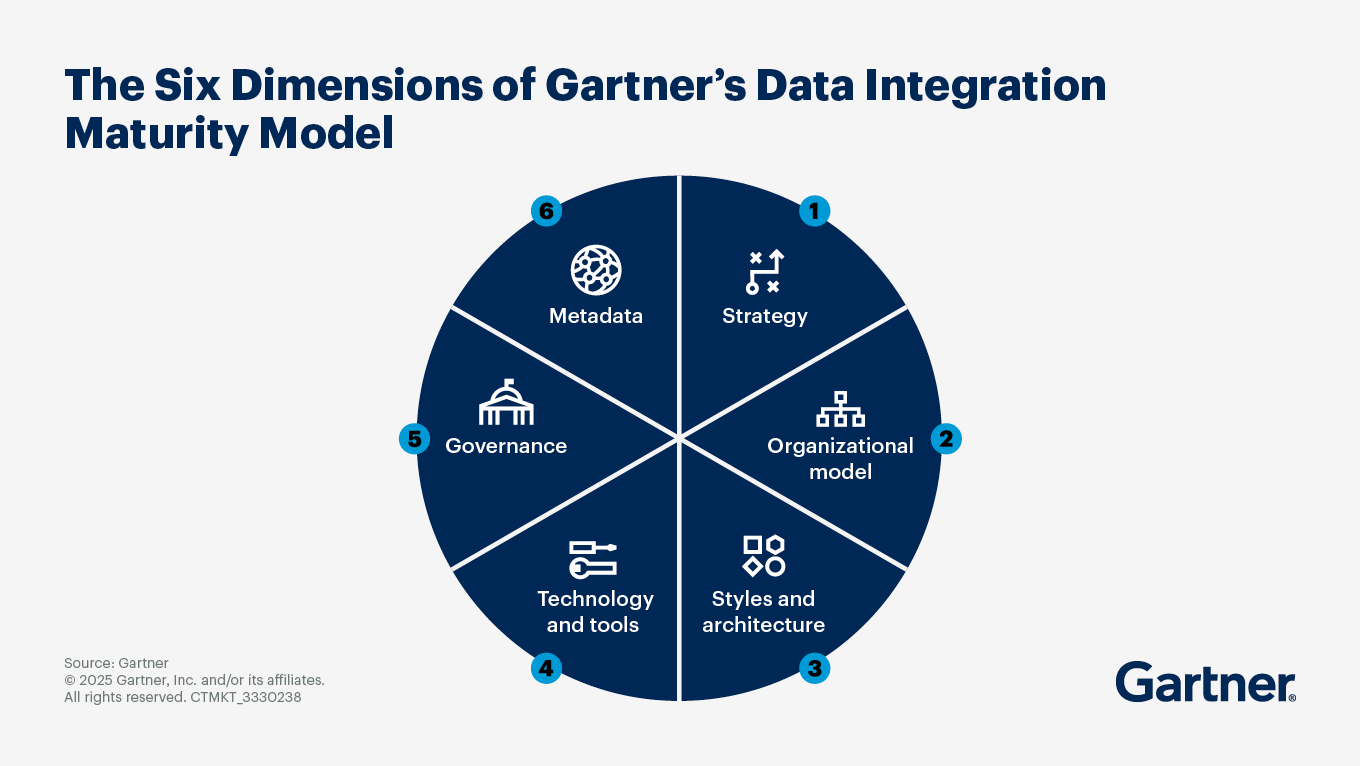
This is also where analysts point. Gartner argues that as integration spreads across more endpoints, domains, and personas, organizations need a coherent, centrally governed integration capability and should adopt a federated governance model — keeping centralized ownership of shared policies while partially decentralizing execution. The estate-wide visibility and standards that make this possible are exactly what an undocumented, project-by-project approach lacks.
The four pillars of an integration governance framework
Pillar 1 — Integration inventory (know what you have)
You cannot govern what you can't see. The foundation of governance is a living inventory of every integration: what systems it connects, what data flows through it, its direction (one-way or bidirectional), its business criticality, and its current health.
This inventory is not a one-time spreadsheet. It must stay current as integrations are added, changed, and retired — which is why mature teams treat it as an operational artifact maintained by the integration platform or service, not a document that goes stale the day it's written.
Pillar 2 — Ownership and roles (know who's accountable)
Every integration needs a named owner accountable for its health — not a team in the abstract, but a defined role responsible for ensuring the integration is monitored, maintained, and fixed when it breaks.
A workable role model typically includes:
- Integration owner: accountable for a specific integration's health and lifecycle.
- Integration platform / service owner: accountable for the shared tooling, standards, and overall estate.
- Data owners: accountable for approving what data an integration may access and move.
- Security and compliance: accountable for the controls that govern sensitive data flows.
Where many organizations centralize this is in a Service Management Office or equivalent function that owns integration governance across the estate.
Pillar 3 — Standards and policies (know the rules)
Standards make an estate maintainable by someone other than the person who built each integration. They cover how integrations are designed, named, authenticated, error-handled, logged, and monitored. Consistency here isn't cosmetic — it's what allows any qualified engineer to understand, operate, and fix any integration in the estate.
Policies extend standards into rules: which integration patterns are approved, what data classifications require additional controls, what authentication standards are mandatory, and what must be documented before an integration goes live.
Pillar 4 — Controls (know what's enforced)
Controls are where governance has teeth. They define who can create an integration, who approves access to sensitive data, how changes are reviewed before deployment, and how access is revoked. Because every integration is effectively a door into your data, controls are inseparable from integration security — ungoverned integrations are a primary vector for data exposure.
The strongest controls are enforced at build time (guardrails that prevent non-compliant integrations from being created) rather than discovered at audit time (after the risk already exists).
Governance enables citizen integration — it doesn't block it
A common misconception is that governance restricts who can build integrations. The opposite is true when governance is done well.
The move toward low-code tooling and citizen integrators — empowering non-specialists to build their own integrations — removes bottlenecks and is genuinely valuable. Gartner makes the same point: rather than fighting business users' desire to solve their own integration needs, IT leaders should facilitate citizen integrators while implementing guardrails. That conjunction is the whole game. Without standards, ownership, and controls, distributed building produces a sprawl of undocumented connections. The governance layer is precisely what makes it safe to let more people build: it provides the guardrails so that scaling the number of builders doesn't multiply the chaos.
This also argues against governing one platform at a time. The ebook premise behind Integration Ops is to think in terms of broader ecosystem support rather than single-platform thinking — escaping the lock-ins, gaps, and inconsistent controls that appear when each vendor's tool governs only its own corner of the estate.
True integration governance is operational, not bureaucratic
The reason governance has a poor reputation is that it's often implemented as documentation theater — a policy written, filed, and ignored. That approach creates the appearance of control without the substance.
Effective integration governance is operational. It lives in:
- Continuous monitoring that surfaces failures and drift in real time (see proactive monitoring for IT service integration).
- Enforced ownership that ensures someone responds when an integration breaks.
- A self-maintaining inventory that reflects the estate as it actually is.
- Build-time controls that prevent non-compliant integrations rather than auditing them after the fact.
This is the operating model behind Integration Ops: governance embedded into how integrations are run, the way DevOps embedded governance into the software pipeline rather than delegating it to a committee. A managed integration service operationalizes much of this governance by default — maintaining the inventory, enforcing standards, and owning monitoring and controls as part of the service.
How to establish integration governance (practical steps)
- Build the inventory first. You can't govern an estate you can't see. Catalog every existing integration, its endpoints, data flows, owner, and criticality.
- Assign ownership. Give every integration a named owner; establish the platform/service owner and data-owner roles.
- Write standards before you need them. Define design, naming, authentication, logging, and monitoring standards while the estate is still small enough to apply them retroactively.
- Implement build-time controls. Put guardrails on who can create integrations and what data they can access.
- Make it operational. Wire governance into monitoring and ongoing operation so the inventory stays current and ownership stays active — rather than letting it decay into a stale document.
Bottom line on integration governance
Governance is not the brake on a growing integration estate — it's what lets the estate scale without collapsing into an undocumented, unowned, unauditable liability.
The four pillars are simple to state and decisive in practice:
- know what you have (inventory),
- know who's accountable (ownership),
- know the rules (standards),
- and know what's enforced (controls).
Establish them while the estate is small and cheap to govern, not after it's large and you're reverse-engineering connections built by people who've left. Done well, governance doesn't restrict who can build — it provides the guardrails that make letting more people build survivable.
Run integrations like an operation. Not a project. Schedule an introduction with ONEiO Managed Integrations specialists.