

Quick answer
If you need data management, Informatica alternatives are Talend, Microsoft Azure Data Factory, IBM InfoSphere, Oracle Data Integrator and SAP Data Services. If your real requirement is service integration between business systems and service desks, that is a different category, covered by self-service iPaaS platforms or managed iPaaS providers such as ONEiO.
If you’ve found this article you’re either an Informatica customer looking for a modern integration solution, or you’re exploring better ways to manage IT service integrations. In both cases, I’ve got relevant information and options for you.
Key takeaways
- Informatica is a data management platform. ETL, data quality, lineage, governance and master data management at enterprise scale. It is very good at that.
- It is not a service integration tool, and most people looking for an Informatica alternative are discovering that distinction rather than finding a fault.
- Salesforce completed its acquisition on 18 November 2025, valued at roughly $8bn, placing Informatica alongside MuleSoft in the same company.
- If you need data management, the alternatives are Talend, Azure Data Factory, IBM InfoSphere, Oracle Data Integrator and SAP Data Services.
- If you need service integration, the alternatives are self-service iPaaS platforms you operate, or managed iPaaS where the provider runs the integrations under an SLA.
Quick comparison
Informatica integrations factsheet
Informatica is one of the most established data management platforms especially known for its ETL solutions and broad range of enterprise data management capabilities.
At the heart of Informatica’s data integration solutions is PowerCenter - an on-premise ETL tool capable of handling large data volumes. As part of its broader set of solutions, Informatica also offers an Intelligent Cloud Services platform designed to support a wide range of cloud integration patterns and use cases, from simple point-to-point integrations to more advanced, multi-step workflows. IICS includes a low-code, visual development environment that enables both technical and non-technical users to build and manage integrations.
Informatica was founded in 1993 and is headquartered in Redwood City, California. It serves over 5000 enterprise customers across various industries, including financial services, healthcare, public sector, manufacturing, and retail. Informatica was acquired by Salesforce on November 18, 2025 to compliment their Mulesoft integration platform.
What Informatica does well
Informatica's Intelligent Data Management Cloud handles enterprise data work at a scale few competitors match: extracting, transforming and loading data, data quality and cleansing, lineage and governance, and master data management.
If your problem is that data is inconsistent, ungoverned or trapped in silos, Informatica is a strong answer and this article is not arguing otherwise.
It has continued to operate across clouds since the Salesforce acquisition closed, expanding its Microsoft Fabric and Azure integration in March 2026.
Why teams look for an Informatica alternative
Category mismatch. The most common reason is that the requirement turned out to be service integration rather than data management. Connecting a service desk to a partner's, syncing tickets bidirectionally, mapping fields between two organisations' systems: Informatica was never built for that, and forcing it produces expensive disappointment.
Cost and weight. Informatica is enterprise-priced and enterprise-heavy. For organisations whose actual requirement is narrower, it is oversized.
Portfolio uncertainty. Salesforce now owns both Informatica and MuleSoft. If you chose two vendors deliberately for resilience, that assumption no longer holds, and roadmap overlap is a reasonable question to put to your account team.
Popular alternatives to Informatica for IT service integrations
ONEiO
ONEiO is a managed iPaaS: a cloud integration service where ONEiO designs, runs, monitors and maintains the integrations end to end, with SLA-backed outcomes and 24/7 operations. Self-service iPaaS is a platform you buy and operate. Managed iPaaS delivers the same integration outcomes, with the provider operating them. The capability is the same. The difference is who operates it.
HQ:
Helsinki, Finland
ONEiO connects each system once to a shared integration layer instead of building point-to-point connections, so tools can be replaced and ecosystems can grow without integrations breaking. Delivery is standardised and priced as a subscription, either volume-based or fixed per integration, which keeps cost predictable. ONEiO has deep domain expertise in ITSM, managed service provider and B2B eBonding scenarios, where the same incident, request or change record has to stay consistent across organisations that do not share a service desk. Most integration vendors build it and hand it back. ONEiO takes operational ownership permanently, and customers decide how much control they keep. Choose ONEiO when you want integration outcomes without staffing an integration team. Choose a self-service iPaaS when you have mature in-house integration engineering and want maximum platform control. ONEiO designs, runs and maintains the integrations, 24/7 under SLA.
Overall rating



Customer support rating
Pros:
- Fully managed and SLA-backed. ONEiO runs the complete integration lifecycle, from design and deployment through 24/7 monitoring and maintenance, so reliable integrations do not require an in-house integration team.
- Built for complex, changing environments. Each system connects once to ONEiO instead of point-to-point builds, with deep domain expertise in ITSM, MSP and B2B eBonding scenarios.
- Predictable cost and fast delivery. Fixed subscription pricing, volume-based or per integration, with standardised delivery in weeks rather than months.
Cons:
- Not a self-service platform. If you have a mature integration team and want hands-on platform control, a self-service iPaaS gives you more of it.
- No full API management suite. ONEiO is not designed for API productisation such as gateways, developer portals or API monetisation.
- Cloud-only. On-premise systems can be integrated, but ONEiO itself cannot be deployed on-premise, which is a constraint for air-gapped or strict data-residency environments.
Mulesoft
MuleSoft Anypoint Platform is a self-service enterprise iPaaS built around an API-first approach to integration. MuleSoft is a Salesforce company, and the platform appeals to large IT organisations and system integrators, especially those already in the Salesforce ecosystem.
HQ:
San Francisco, California
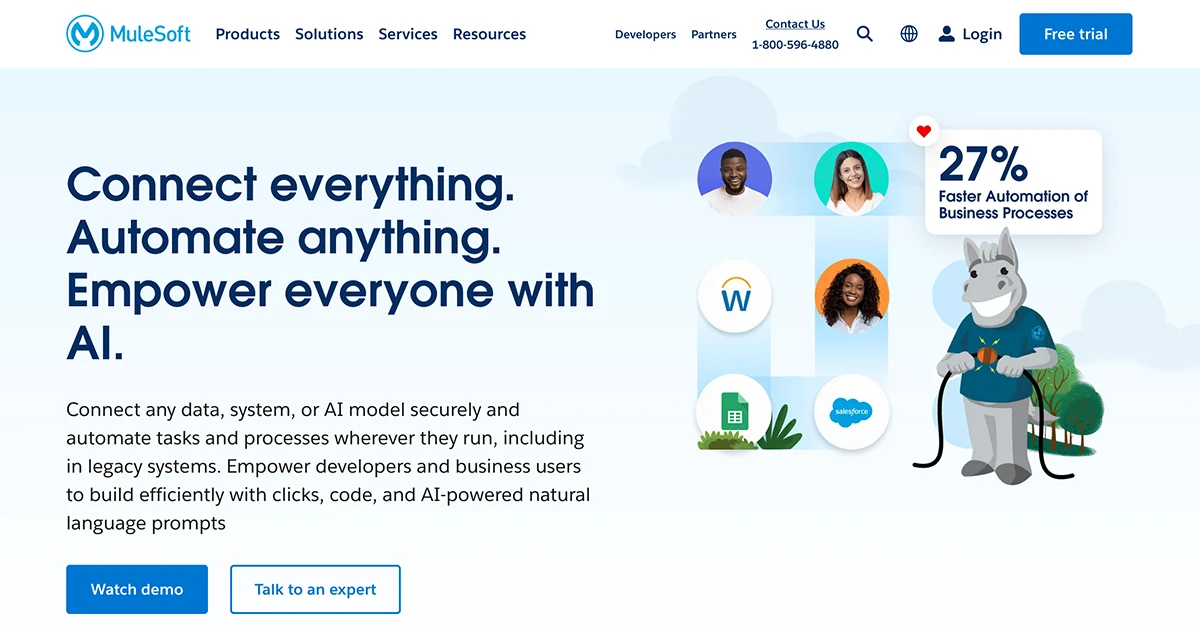
Anypoint Platform combines API design, API management and integration in one self-service platform, with API-led connectivity as its organising principle. Salesforce has extended it into agentic AI through MuleSoft Agent Fabric, which registers, orchestrates and governs AI agents from any vendor, and has since added automated agent discovery and a control plane for multi-agent governance. MuleSoft suits organisations with in-house integration engineering that want an API-led strategy and are prepared to staff the platform. Your team designs, runs and maintains the integrations.
Overall rating
Customer support rating
Pros:
- API design, management and lifecycle governance in a single platform.
- Large template and connector library, with automation and RPA tooling.
- Agent Fabric adds a registry, observability and policy control for multi-vendor AI agents.
Cons:
- One of the highest costs of entry in the iPaaS market, with complex pricing.
- Strongest fit inside the Salesforce ecosystem.
- Users report steep learning curve, and dedicated MuleSoft skills are needed to run it.
Celigo
Celigo is a self-service iPaaS focused on SaaS integration and back-office process automation, aimed mainly at mid-market and upper-midmarket companies.
HQ:
Redwood City, California
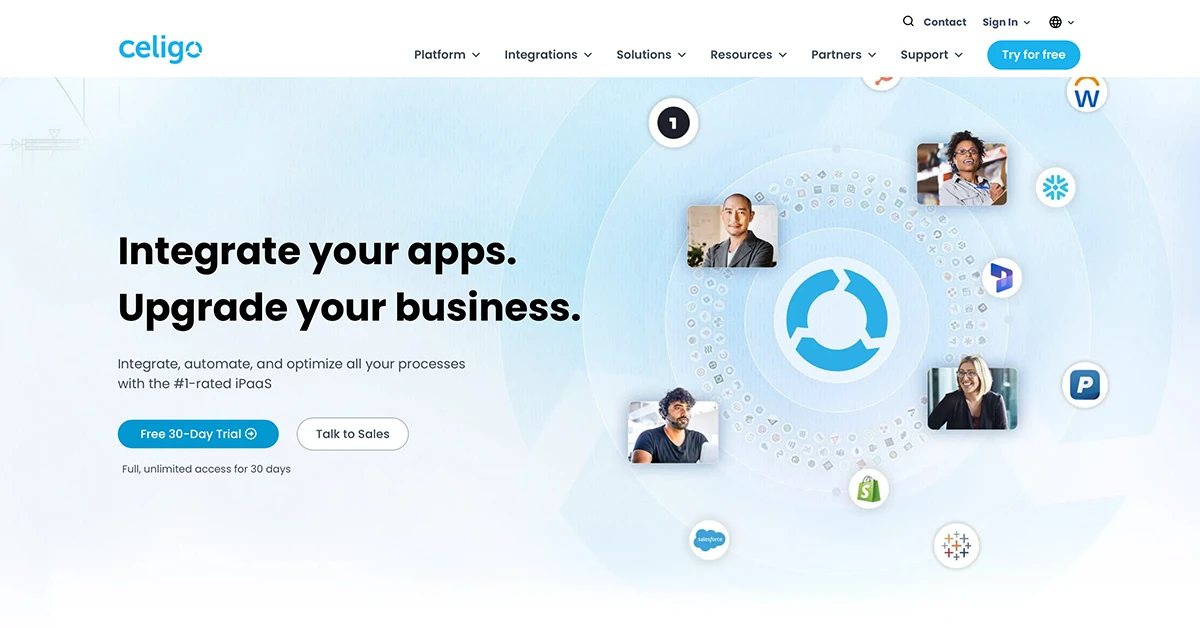
The Celigo integrator.io platform combines a large library of business-process templates with automated error handling, and is strongest in finance, e-commerce and NetSuite-centred back-office work. In March 2026 Celigo launched Ora, a natural-language copilot, together with Agent Builder, which lets business teams build and govern AI agents on top of existing integrations. B2B integration and developer experience are the stated roadmap priorities. Celigo suits teams that want business users building automations with IT oversight. Your team designs, runs and maintains the integrations.
Overall rating
Customer support rating
Pros:
- AI-assisted categorisation and resolution of runtime errors.
- Large library of business-process templates, strongest in NetSuite and e-commerce.
- Ora and Agent Builder let non-developers build governed AI agents.
Cons:
- Fewer enterprise controls at large scale.
- Operational data is difficult to export to external monitoring tools.
- Interface complexity grows quickly beyond template-based use.
Jitterbit
Jitterbit Harmony is a self-service iPaaS that started with small and midsize businesses and has moved upmarket, competing on flexibility and price.
HQ:
Alameda, California
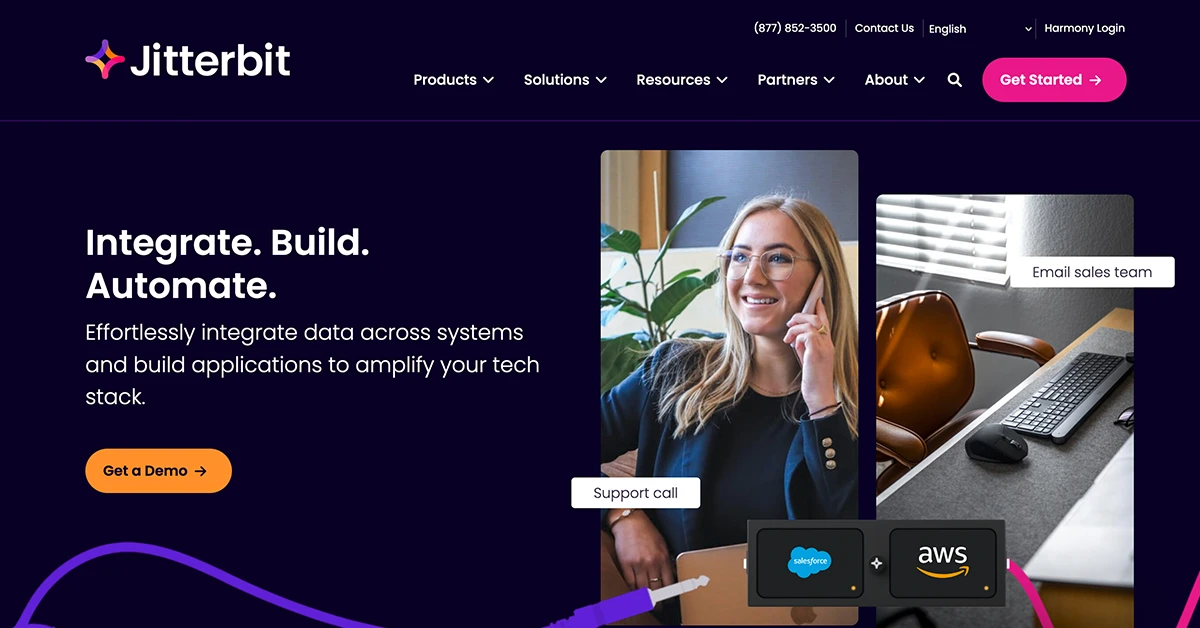
Jitterbit Harmony covers application integration, API management and EDI in one platform, with a predictive pricing model and a focus on making integration accessible to non-specialist developers. The company has been building out AI assistants and an agent marketplace, and appointed Mark Logan as President and Chief Executive Officer in August 2026, with former chief executive Bill Conner moving to the board. Its systems integrator ecosystem is smaller than those of the larger platform vendors. Jitterbit suits general iPaaS needs and EDI modernisation. Your team designs, runs and maintains the integrations.
Overall rating
Customer support rating
Pros:
- Strong EDI capability with a substantial template set.
- Straightforward interface that is quick to get started with.
- Customisable template marketplace, useful for OEM and partner delivery.
Cons:
- Smaller prebuilt connector and template library than the market leaders.
- Endpoint-based pricing is hard to model.
- Smaller partner and systems integrator ecosystem.
SnapLogic
SnapLogic is a self-service low-code integration platform for building data and application pipelines through a visual interface. Since 2026 it positions itself as an agentic integration company.
HQ:
San Mateo, California
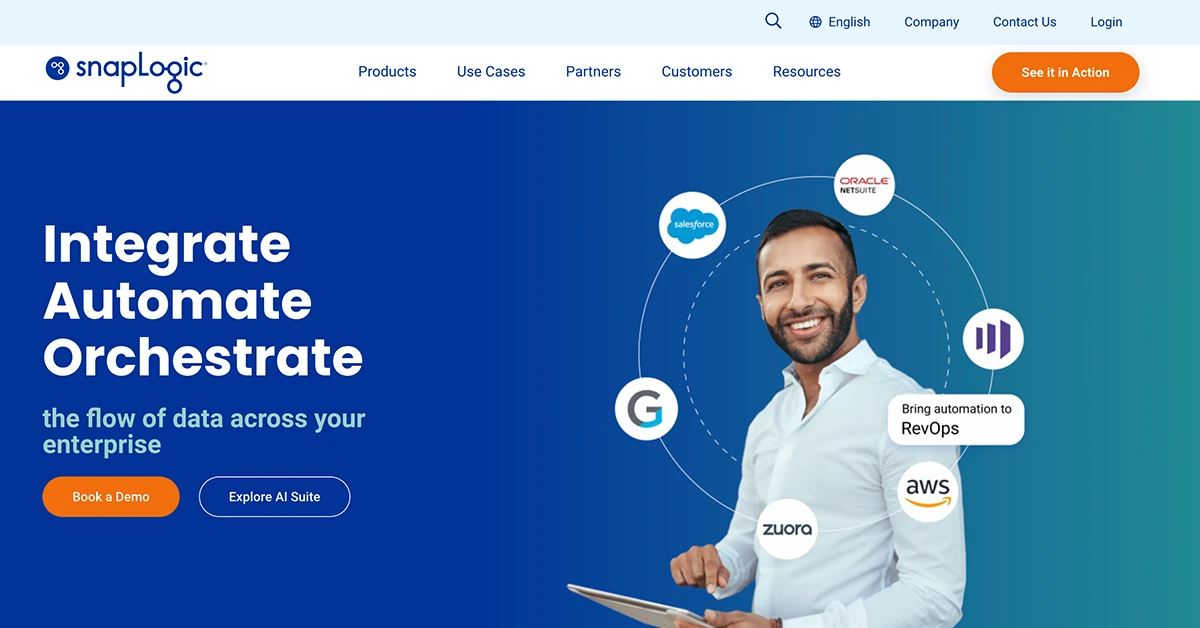
The SnapLogic Intelligent Integration Platform uses a drag-and-drop pipeline builder with a large library of pre-built connectors called Snaps, covering ETL-style data integration, real-time application integration and API creation with minimal coding. In July 2026 SnapLogic relaunched SnapGPT as an agentic assistant covering the whole integration lifecycle, from building and testing pipelines to documenting and troubleshooting them, alongside an AI Gateway and Trusted Agent Identity for governing what agents are allowed to reach. B2B and EDI capability remains modest. Your team designs, runs and maintains the pipelines.
Overall rating
Customer support rating
Pros:
- Visual pipeline builder that is quick to learn for common patterns.
- Transparent pricing and presence on the major cloud marketplaces.
- SnapGPT now spans the full integration lifecycle rather than pipeline generation alone.
Cons:
- Limited B2B and EDI capability.
- Coarse access permissions for larger teams.
- Debugging and advanced use carry a real learning curve.
TIBCO
TIBCO has a long legacy in enterprise integration and messaging, and is known for powering mission-critical, high-throughput systems. It has been part of Cloud Software Group since 2022.
HQ:
Santa Clara, California
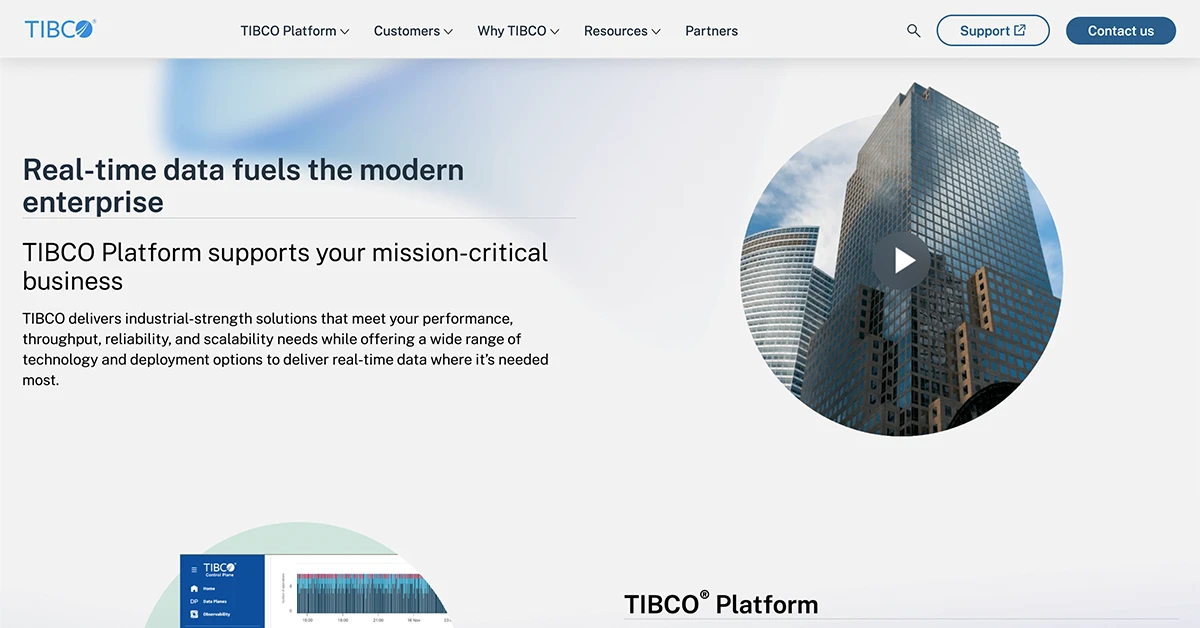
The TIBCO Platform brings integration, messaging, API management and data products together for organisations running high-volume, latency-sensitive workloads, often in financial services, telecoms and logistics. TIBCO has been part of Cloud Software Group since the 2022 combination with Citrix. Its 2026 AI work centres on adding model and agent capability into existing BusinessWorks flows rather than launching a separate agent platform, which suits customers protecting a large installed estate. TIBCO fits data-centric integration strategies in enterprises that already run TIBCO. Your team designs, runs and maintains the integrations.
Overall rating
Customer support rating
Pros:
- Proven at very high message volumes and low latency.
- Wide range of integration styles within one portfolio.
- Volume-based pricing that flexes with usage.
Cons:
- Inconsistent experience across a portfolio assembled over many years.
- Some capability is available only self-hosted.
- Slower release cadence than the cloud-native vendors.
Workato
Workato is a self-service iPaaS focused on process automation and on collaboration between IT and business teams through an AI-assisted interface.
HQ:
Mountain View, California
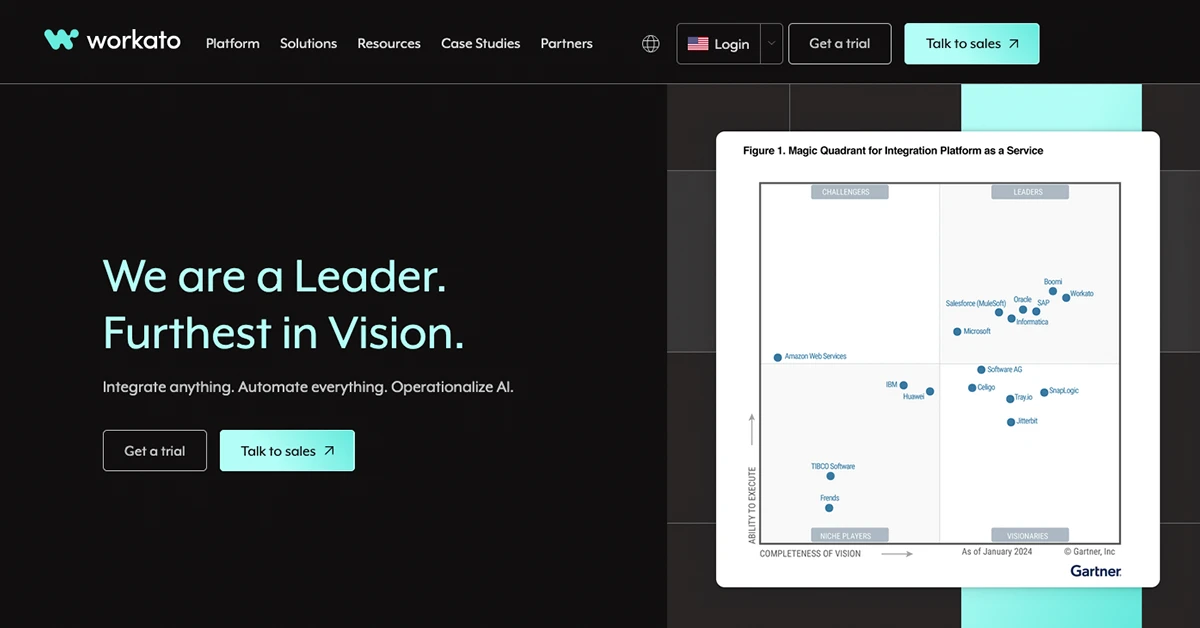
Workato runs a serverless integration platform with a large connector library and an emphasis on letting business teams build their own automations under IT governance. Its 2026 direction is agentic: Agent Studio lets teams build AI agents on top of existing recipes, and the July 2026 release added a Headless API for embedding those agents into any business application, plus Agent Guardrails for policy control over what the agents are permitted to do. Workato suits cloud-based business process automation where IT and business teams build together. Your team designs, runs and maintains the automations.
Overall rating
Customer support rating
Pros:
- Approachable interface with AI-assisted recipe building.
- Very large connector and template library.
- Agent Studio, Headless API and Agent Guardrails bring governed AI agents into business applications.
Cons:
- Task-based pricing escalates as more processes are added.
- No out-of-the-box EDI or B2B capability.
- Cloud-only, with no on-premise deployment option.
SAP
SAP offers iPaaS functionality as part of its SAP Business Technology Platform, emphasizing integration within the SAP ecosystem.
HQ:
Walldorf, Germany
The SAP Integration Suite, part of the SAP Business Technology Platform, offers comprehensive integration capabilities. It focuses on SAP-centric ecosystems, aiming to unify business data and processes with a strong emphasis on AI. The suite's flexibility and extensive template library make it a robust option for businesses heavily invested in SAP products, offering a path towards digital transformation with a focus on modern application architecture.
Overall rating
Customer support rating
Pros:
- Thousands of templates, primarily for SAP applications.
- Global operational and support presence through SAP
- Transparent pricing.
Cons:
- Perceived primarily as an SAP-centric tool.
- Business model leans heavily towards SAP applications.
- Pricing not tailored to all market segments.
How to choose
Are you moving data, or connecting processes? Data moves for analytics and reporting. Processes connect so work flows between teams and organisations. Informatica does the first extremely well. If you need the second, look at the bottom two rows of the table.
Does the integration cross an organisational boundary? If yes, ongoing maintenance dominates the total cost, because the other side changes without warning and you do not control it.
Do you have data engineers? If the constraint was tooling, another data platform will help. If the constraint was people, it will not.
Why your best Informatica alternative might not be a platform at all
If you arrived here because Informatica turned out to be the wrong category, be careful not to make the same mistake one level down.
Service integration is not hard because the tooling is hard. It is hard because the systems on both ends keep changing, and in cross-organisation integration you control only one of them. A platform gives you a better place to do the work. It does not do the work.
Managed iPaaS does. ONEiO is a managed integration service that delivers iPaaS outcomes without the customer operating a platform: designing, running, monitoring and maintaining the integrations, with SLA-backed outcomes and 24/7 operations.
Informatica remains the right answer for ETL, data quality, governance and MDM. These are not substitutes.
Bottom line
Most people searching for Informatica alternatives are not unhappy with Informatica. They have realised they bought a data management platform to solve a service integration problem.
If that is you, the useful move is not comparing data platforms. It is stepping back one level and asking which category the problem actually belongs to.
If you genuinely need data management, stay in that category. Informatica is one of the strongest options in it, and the Salesforce acquisition has not changed that in the near term.