Manufacturing
IT operations
Production uptime is on you. Coordination between your suppliers isn't.
That’s where ONEiO steps in.
Managed integrations for manufacturers running complex, multi-vendor supply networks. One platform connecting every endpoint and orchestrating every flow.




















Managing manufacturing IT is hard. We get it.
Manufacturing depends on a tangled network of partners. Contract manufacturers, logistics providers, supplier ERPs, and the systems across your supply chain management (SCM) landscape: WMS, TMS, MES, planning and APS, EDI and B2B networks, CRM and commerce, PLM and quality.
Each with its own tools, its own service commitments. Frequently with patchy or missing connections to the rest of the chain. And, worst case, to your core ERP and operations systems.
But it’s not a technology problem. It's a question of how the whole system operates together.
You shouldn't be left to hold this together alone.
You own the outcomes, but the setup you've inherited doesn't back you up when something goes wrong.
It's an intricate ecosystem, and success depends on having control and visibility. When a line halts or an order is stuck, you're left navigating exceptions spread across multiple suppliers and systems. Each with its own tools, its own contract.
That lack of coordination drags out resolution. And your downstream partners and customers won’t wait.

Most integrations are fine. Until they aren’t.
On a normal day, you're monitoring operations and filing reports. But the moment a line stops or a shipment slips, it turns into a business issue with real revenue at stake.

From there, how fast you react depends on people coordinating manually - not on flows moving in real time across planning, production, and logistics. It gets messy fast. Your team logs a ticket and waits, hearing nothing.
People chase answers. Orders further down the chain and partner teams go without what they need. Service levels slip. You piece together a fix by hand. Nothing gets logged properly, there’s no audit trail, and change process gets skipped entirely.

Nobody's sure who owns the handoff. Hours disappear into back-and-forth blame between you and your suppliers. You get through it, but nobody comes out feeling good - not your team, not your suppliers, not the business.
Get one view across your whole system
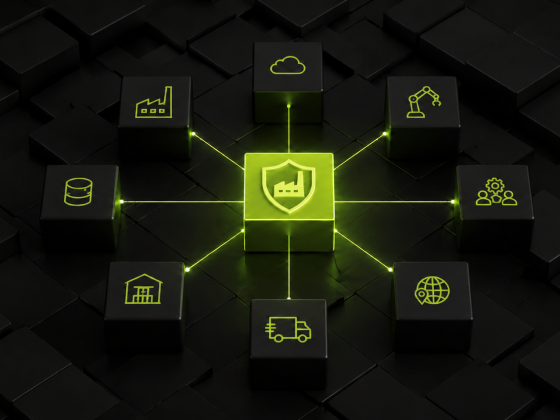
ONEiO connects every endpoint in your supply chain landscape - suppliers, logistics partners, ERP, WMS, TMS,MES and more. Each connects once, then takes part in any flow. Your vendors don’t change a thing. What changes is the connection between them.
We turn them into a single operating model and orchestrate every flow across it. Every process is mapped as a swimlane, one lane per system or team, so ownership, handoffs and exceptions are visible end to end. What happens at the handoffs is no longer yours to chase by hand.
You get control and visibility, with a clear line of sight into production, so you can step in when it matters and own the result.
Stop firefighting. Keep things moving.

Supply Chain / Operations Leader
Your supplier and logistics network was designed to operate as one. On paper. In reality, you know that's not how it plays out. Contract manufacturer, 3PL partner, supplier ERP, warehouse platform - each running its own contract and service terms.
What's missing is real-time, operational-level connection into your planning, production, and fulfilment - plus core data like inventory or master records. When production halts or an order gets stuck, pulling it together falls to you.
You answer for results you don't fully control, inside a setup that was never designed for how manufacturing actually breaks down.
With ONEiO: You get a single view, inside whichever systems you already use, no need to change them.
- Orders and signals are route and transformed automatically across supplier and partner lines.
- Master data stays current no matter who owns it. Multiple sources. Real time.
- You own outcomes, get ahead of problems, and hold suppliers to what they've promised.

CIO / Head of IT Operations
When a line's down, the details are secondary. What you need is a timeline for the fix and a name attached to it.
Complexity isn't really the problem. Unpredictability is. You can't tell a plant manager when the line comes back.
You can't tell the board it won't happen again, especially not while you're mid-acquisition or mid-transformation.
With ONEiO: You get complete visibility and control across the entire operational ecosystem, end to end.
- Say yes to a new supplier, plant, or acquisition, and nothing breaks.
- Become the connective layer your ecosystem relies on, and the partner your business trusts.
- Your team owns the process, not the plumbing
Use an operating model you can rely on

Built to master complexity
New suppliers, acquisitions, new plants - the integration layer takes each one on as another endpoint that connects once and then joins any flow, without extra headcount.
Built for continuity
Round-the-clock AI monitoring. Issues resolved before the business notices or production takes a hit. Upgrades and changes handled without disrupting flow.

Built for certainty
We take on the entire integration lifecycle - infrastructure, operations, expert support. You make the promises to the business. We make good on them.
Run manufacturing IT the way the business needs it
Keep the line moving. When issues get resolved at the pace of the operating model, not manual back-and-forth, output stays on track.
More suppliers. No extra headcount. A new supplier used to mean more coordination work. Not anymore. The integration layer scales — your team doesn't have to.
Grow through M&A. Don't multiply the risk. An acquisition used to mean starting a new integration project from zero. Now it just slots into the operating model already in place.
Ready to see what running manufacturing IT on your terms looks like?