

Zero tickets is one of the most misread goals in IT support. Some teams hear it as getting the inbox to zero by Friday. Others hear it as customers logging their own requests in a portal, so the team no longer raises tickets for them. Neither has much to do with the standard.
Zero ticket IT means nothing broke that a user would otherwise have to report. For many service providers and enterprise IT teams, the tickets that could have been avoided start somewhere the user never sees: in the integrations between systems.
Key takeaways
- Proactive IT support prevents issues or fixes them before users notice. Faster reaction is still reactive.
- Zero ticket IT means nothing broke that a user would otherwise have to report. It is not inbox zero, and it is not moving the reporting into a self-service portal.
- Integration failures generate avoidable tickets because the business usually finds them first. Only 19% of leaders in recent research first learned of their worst integration failure from an automated alert. The rest found out from a system throwing errors, an order that never synced or a customer calling about a missed service level.
- Getting there takes four things: an owner for every system and integration, visibility of the business process end to end, planned handling of change, and causes removed so the same fix is never needed twice.
- The payoff reaches well beyond the service desk: fewer interruptions, more productive teams, a business that can make promises and keep them, and people who stay.
The operating discipline behind this. The Integration Ops book sets out how Managed Integration Services monitor, maintain and measure integrations as a continuous service. Download the book.
What is proactive IT support?
Proactive IT support is an approach to IT service delivery in which problems are detected and resolved before users are affected, and their causes are removed so they do not recur. Its measure is how few tickets need to be raised, not how fast they are closed. In practice it combines monitoring of business processes, clear ownership of every system and integration, and planned handling of change.
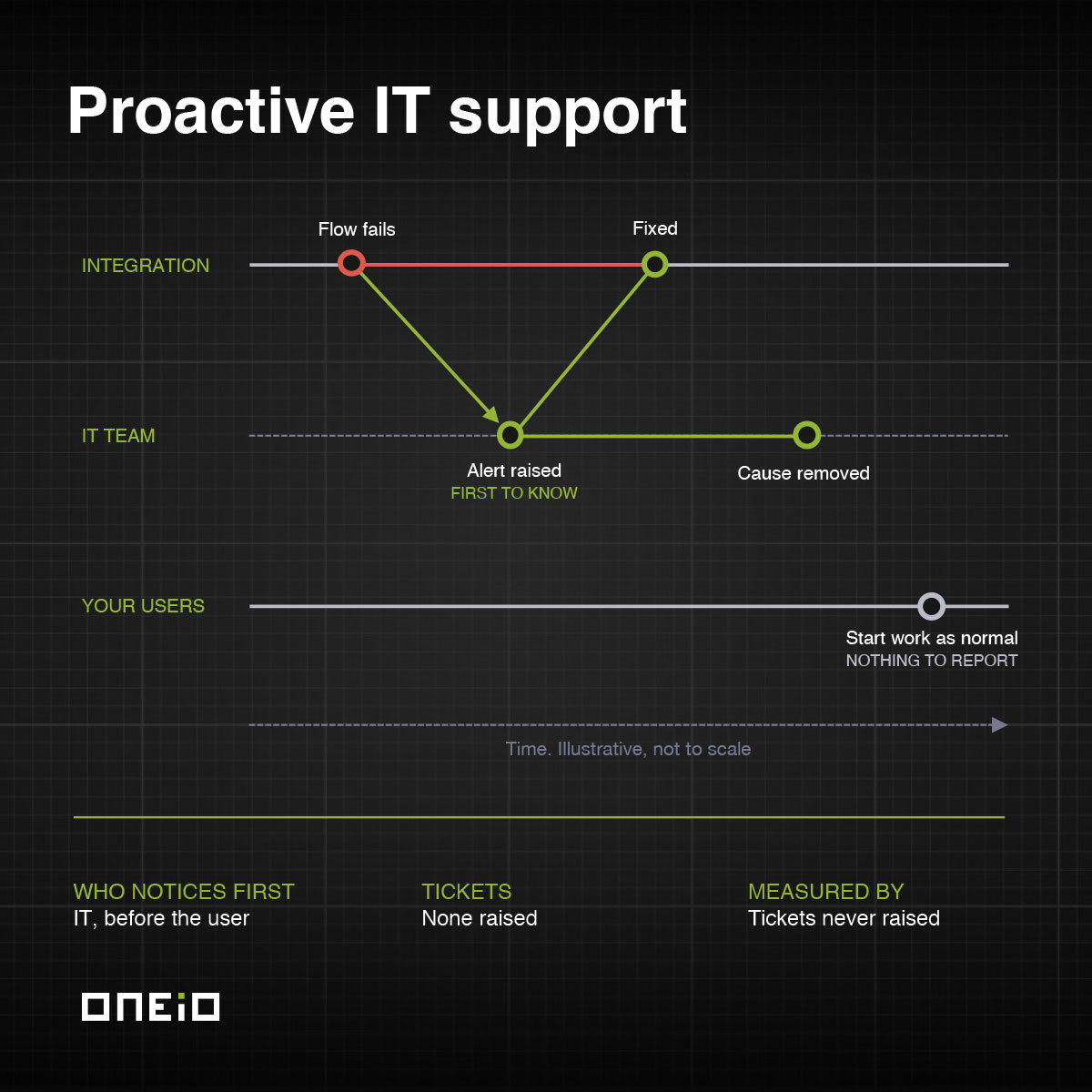
The clearest way to tell the two models apart is to follow a single failure and ask who notices it first. In reactive support, the user does. The flow stays broken while they spot the problem, raise a ticket and wait for IT to triage and fix it.
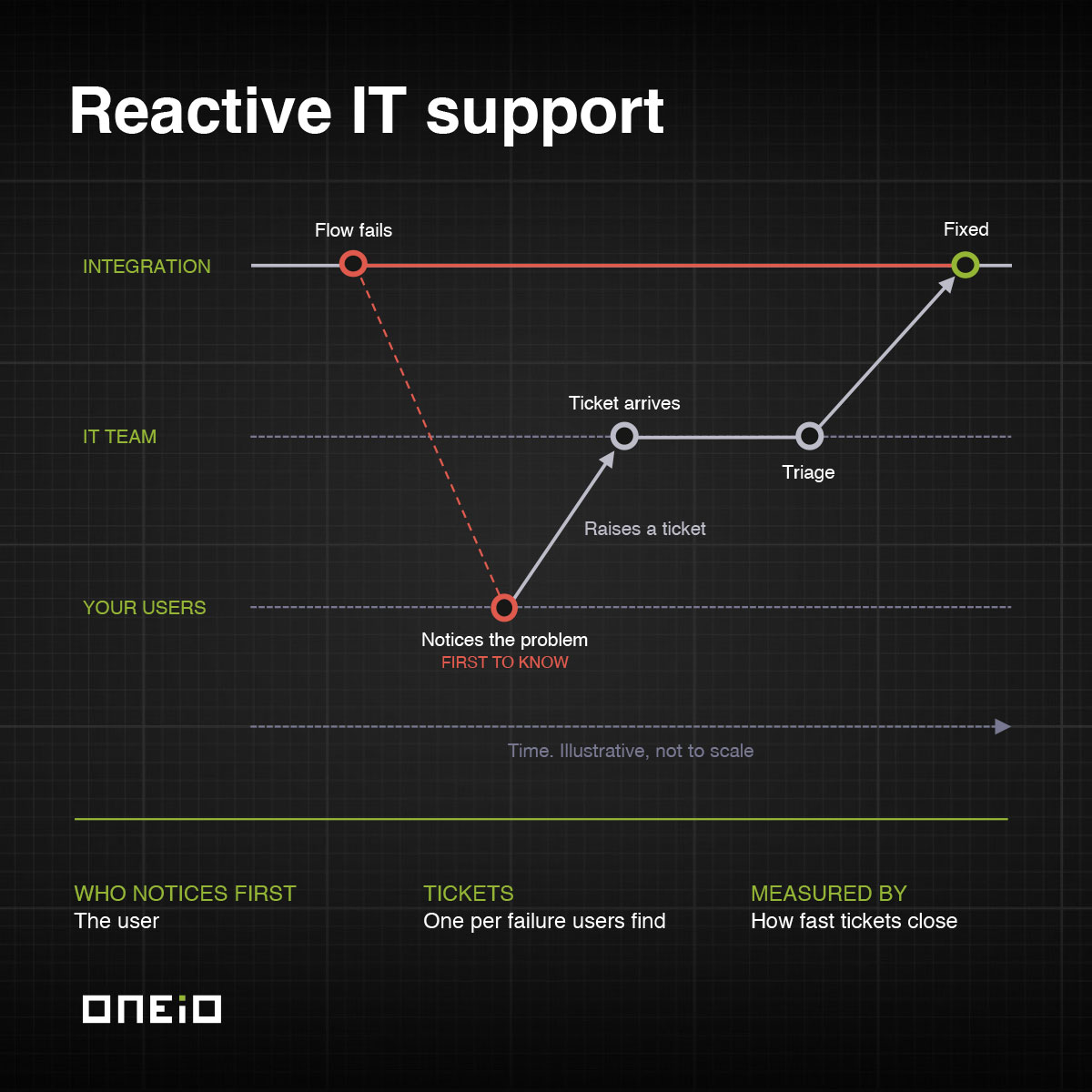
In proactive support, an alert reaches IT first. The flow is fixed before users are affected, the cause is removed so the same failure does not return, and nobody has a ticket to raise.
Why zero tickets usually means faster reaction
Most of what gets presented as progress towards zero tickets makes the reactive loop quicker. Better alerting, smarter routing, automated triage and self-service portals all shorten the time between something breaking and someone fixing it. They are worth having. They also all start after something has broken.
Jaro Tomik, founder of Buvalo and a former chief technologist in enterprise IT and managed services, sets the bar higher. For him, staying ahead of the user is the job:
"I should already know that they need to raise a ticket. I should be well ahead of my game."
Jaro Tomik, Buvalo
Being ahead means knowing that a user's application is not performing as it should before the user says so, and better still, removing the reason it would stop performing. Our guide to proactive monitoring for IT service integration covers the monitoring capabilities this depends on.
The zero ticket IT standard
Jaro states the goal in one line, and it doubles as the definition of zero ticket IT. Everything else in this standard follows from it:
"We want integration so reliable, nobody has to think about it."
Jaro Tomik, Buvalo
A ticket is evidence that a user noticed a failure before IT did. Each one avoided is a failure that was prevented or fixed in time. Paula at Telia describes the same standard from the service provider's side:
"Keep customers out of your technical mess, catch and fix issues before they notice."
Paula, Telia
Michael Manea, VP Global Business Services at All for One, describes what it looks like on a normal night in application management. The fix happens before the customer starts work:
"After that patch, three a.m. in the morning, something broke. We're going to need to fix that that night. So when the customer comes in the next morning at seven, they can continue the work and never know that something has happened in the background."
Michael Manea, All for One
Zero is a direction, not a promise. Claire Agutter of Scopism, which publishes the Service Integration and Management (SIAM) body of knowledge, is clear that complex systems will fail and that "it's how we respond when things go wrong that sets organisations apart." The standard asks that the response happens before the user is the one who reports it.
Where avoidable tickets come from
Many of the tickets a service desk receives describe a symptom whose cause sits somewhere else. The user sees that a customer record is wrong, an order has not appeared or a dashboard is out of date. What actually failed is a flow between two systems, often two systems owned by different teams or different organisations.
Integration failures are especially good at generating tickets because you cannot see them. The source system reports success. The target system shows no error. The only thing that has gone wrong is that data stopped moving, and the first person to notice is the one who needs it.
Research by Arion Research for ONEiO, which surveyed 451 business leaders in three countries in October 2026, shows how often the business gets there first. Only 19% first learned of their worst integration failure from an automated alert. For 42%, the first sign was information that was missing, wrong or out of date, and for 22% a routine business process could not be completed. Detection decides how long the damage runs: when an alert caught the failure first, 36% of incidents took a day or more to restore, against 55% when the failure surfaced any other way.
Claire Agutter tells the story of a manufacturing time-recording outage serious enough that "somebody got disturbed on the golf course to report it." The cause was a dependency whose status was already public: "it was the lack of understanding of how things knitted together that really created the business impact." A quick search would have found the cause in seconds.
The teams that should be preventing these failures are often too busy repairing them. In ONEiO's own research, 30% of organisations said they were too busy managing and repairing existing integrations to focus on new integration initiatives.
What it takes to get to zero ticket IT
An owner for every system and every integration. A failure without an owner is discovered by the user, because nobody else is looking. Named ownership is what turns an alert into an action. It matters most for integrations, which sit between teams and are easy for every team to assume belongs to someone else.
Visibility of the business process, not just the component. Component monitoring tells you a server or an interface is up. It does not tell you that orders have stopped reaching the warehouse. Watch the outcome the business depends on, and alert on that. Tracking which tickets trace back to integrations is a good start; our guide to IT ticketing metrics and KPIs covers how to measure the service desk.
Planned handling of change. Many failures follow a change: a platform release, an API update, a patch, a new customer onboarded onto a shared flow. Treating each change as a scheduled task with an owner removes a whole class of tickets that would otherwise be found when something breaks. Integrations into the service desk itself are a good place to start.
Removing causes, not repeating fixes. If the same failure returns every month, the support process is working and the service is not. Each repeat incident is a backlog item for prevention, and preventing SLA breaches at the source follows the same logic for service levels.
What it is worth
The case for zero tickets is usually made in service desk terms: fewer tickets, lower cost per ticket. That undersells it. Jaro Tomik follows the value up the chain. Reliable integrations keep data flowing. Flowing data gives visibility. Visibility lets you prioritise. Prioritising prevents problems. Fewer problems mean fewer interruptions, interrupted people get more done, and the people doing the work stop spending their days firefighting. His conclusion:
"Your job from a business perspective may have been set out on your job description as keep your integrations going. Where in fact what you're doing is retaining talent."
Jaro Tomik, Buvalo
The opposite is just as concrete. When IT is mostly visible through its failures, he warns, "the business will work around you rather than with you": shadow tools, workarounds, and decisions taken without IT in the room. Gabriel at Trumpf describes where many teams start:
"We had a lot of firefighting... always the same issues."
Gabriel, Trumpf
And Claire Agutter explains why this is no longer only an IT question: "the impact of a technical failure is a business impact now." Every avoided ticket is a process that kept running, a customer who did not notice and an engineer who worked on something new. Our article on IT service reliability as business expectations grow looks at the same pressure from the service owner's side.
ONEiO applies this standard to integrations through ONEiO Managed Integrations: 24/7 monitoring with proactive escalation, messages held and recovered when a connected system goes down, change absorbed as part of the service, and a service level written against the integrations themselves.
Bottom line on proactive IT support
Proactive IT support is measured by the tickets that never needed raising. Faster reaction improves the experience of a failure. Prevention removes the failure, and the place to look first is the integrations between systems, where problems stay out of sight until a user trips over them.
Zero tickets will not be reached every day, and nobody serious promises it. As a standard, it changes what the team works on: ownership, end-to-end visibility, change handled before it breaks things, and causes removed for good.
Your customers should discover your excellence, not your outages.
See where your tickets start. Schedule a 30-minute conversation and we will walk through which of your incidents trace back to integrations.