

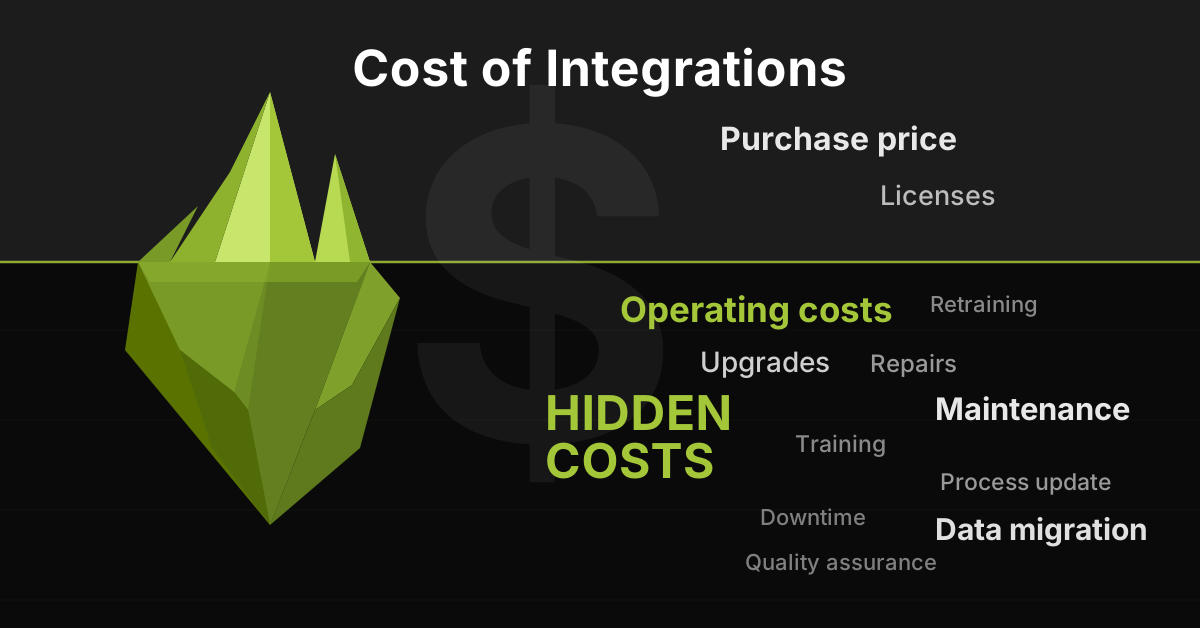
The true cost of an enterprise integration is rarely the number on the proposal. Build cost — the price to design and deploy a connection between two systems — is the visible tip of a much larger total cost of ownership (TCO) that includes ongoing maintenance, monitoring, incident response, and the cost of changing the integration as systems, customers, and requirements evolve. For most organizations, the cost to run and change an integration over its lifetime is three to five times the cost to build it.
This guide breaks down the real, end-to-end cost of enterprise integrations across the three main delivery models — system integrators (SIs), integration platforms (iPaaS), and managed integration services — and gives you a framework to benchmark total cost of ownership rather than sticker price.
Key takeaways
- Build cost is the smallest part of integration TCO. Over a typical 3–4 year lifecycle, maintenance and change costs dominate — often 3–5x the initial build.
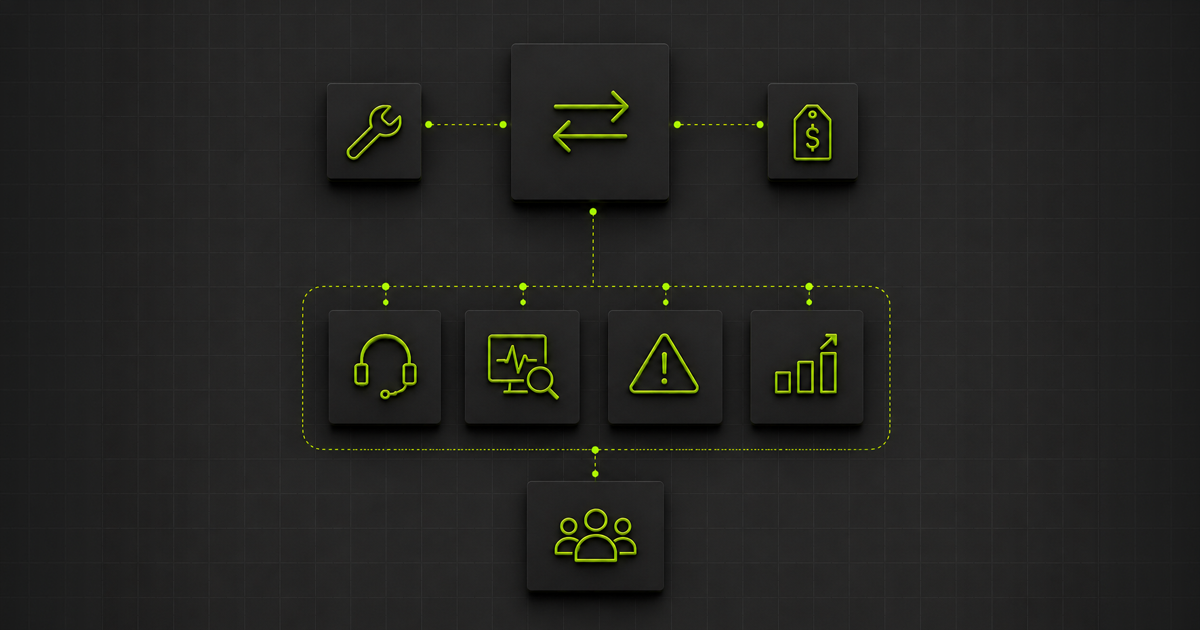
- Three cost drivers determine true cost: cost to build, cost to run (maintenance, monitoring, incident response), and cost to change (new endpoints, platform migrations, scaling).
- System integrators front-load cost into the project and re-bill every change, making them expensive to scale.
- iPaaS lowers per-integration build cost but shifts the long-term operating burden onto your own team.
- Managed integration services convert variable, unpredictable maintenance cost into a fixed, forecastable subscription.
Why integration cost is so hard to pin down
Ask three vendors what an integration costs and you'll get three numbers that aren't comparable. One quotes a fixed project fee. One quotes platform licensing plus implementation. One quotes a monthly subscription. None of them, on their own, tells you what the integration will actually cost you over its life.
The reason is that an integration isn't a thing you buy once. It's a relationship between two or more systems that must be kept working as both ends change. APIs get versioned. Platforms get upgraded. Field mappings break. New customers arrive with systems nobody anticipated. Each of those events has a cost — and almost none of them appear on the original quote. This recurring, hidden expense is what we call the integration tax: the price you keep paying for every business unit you onboard and every process you connect, long after the project invoice has cleared.
To compare options honestly, you have to separate integration cost into three distinct buckets. (For a deeper operational walkthrough, see our guide on how to calculate and control the cost of service integrations.)
The three costs of every integration
1. Cost to build
This is the visible cost: design, development, testing, and deployment of the integration. It's what shows up on a proposal and the number most organizations anchor on.
Build cost varies with complexity — the number of systems, the richness of the data model, whether the integration is one-way or bidirectional, and how much custom logic is required. A simple one-directional API connection between two SaaS tools sits at the low end. A bidirectional, multi-field sync across an enterprise ITSM platform and several external customer systems sits at the high end.
The mistake is treating build cost as the cost. It's the down payment, not the price.
2. Cost to run
Once an integration is live, it has to be operated. That means monitoring it for failures, responding to incidents when (not if) something breaks, and applying maintenance whenever either connected system changes.
This is where most cost hides. Every API deprecation, authentication change, schema update, or rate-limit adjustment on either side can break the integration — and someone has to detect it, diagnose it, and fix it. When that "someone" is your own senior engineers, the cost is real even though it never appears as a line item, because it's buried inside salaries. (This is exactly why we argue that proactive monitoring is a cost-control discipline, not just a reliability one.)
Over a 3–4 year lifecycle, run cost typically dwarfs build cost. An integration that cost €15K to build can easily cost €50K+ to operate over its life once you account for engineering hours, monitoring, and incident response. The pattern shows up at the team level too: IT teams that rely on traditional integration approaches can spend 80–90% of their integration time managing, troubleshooting, and maintaining what they've already built, with organizations wasting around €400K a year keeping outdated integrations alive. That's the integration tax in its purest form — capacity consumed by maintenance rather than value.
3. Cost to change
The third cost is the one that determines whether your integration strategy scales or strangles you: the cost of changing the integration estate as your business grows.
Add a new customer with a different ITSM platform. Migrate from one system to another. Absorb an acquired company's tech stack. Each of these is a change, and in some delivery models, each change is effectively a new project — a new quote, a new build cycle, a new wait.
If your cost to change rises every time you grow, your integration model is working against your business model. This is the core argument behind Integration Ops: integration cost should scale sub-linearly with growth, not linearly with it.
The three delivery models, benchmarked
System integrators (SIs)
System integrators deliver integration as a professional-services project. You scope the work, they build it, you pay a project fee.
Cost to build: High and front-loaded. SI day rates are premium, and the project model bundles discovery, design, build, and handover into one large invoice.
Cost to run: Variable. Some SIs offer ongoing support contracts; many hand the integration back to you and your operating cost becomes internal. Either way, you're paying premium rates for maintenance.
Cost to change: Highest of the three models. In a project model, every change is a new engagement — a new statement of work, a new quote, a new timeline. The cost of change is effectively the cost of re-buying.
Best for: One-off, highly custom, deeply complex integrations where the relationship genuinely is a project with a defined end. Poorly suited to a growing estate of integrations that change frequently. We unpack when this model breaks down in alternatives to system integrators.
iPaaS (integration platform as a service)
iPaaS gives you a platform with pre-built connectors and visual tooling to build integrations yourself or with light professional services.
Cost to build: Lower per integration than an SI, thanks to reusable connectors and visual builders — once you've absorbed the platform learning curve and licensing.
Cost to run: This is the catch. The platform makes building easier but does not operate the integrations for you. Your team still owns monitoring, incident response, and maintenance. As the estate grows, so does the operating load — and platform upgrades themselves can become a maintenance event. (See iPaaS vs. Integration as a Service for where this line falls.)
Cost to change: Moderate. New integrations are cheaper to build than with an SI, but every one you add increases the operating surface your team has to maintain.
Best for: Organizations with dedicated integration engineering capacity who want control and are willing to own the operating burden. For a current landscape view, see our iPaaS solutions comparison.
Managed integration services
A managed integration service delivers integration as an operated, ongoing service rather than a platform you run or a project you commission. The provider builds, monitors, maintains, and changes the integrations on your behalf, typically under a fixed subscription.
Cost to build: Bundled into the service. There's no large upfront project fee; build is part of onboarding.
Cost to run: Fixed and predictable. Monitoring, incident response, and maintenance are the provider's responsibility, not yours. The operating burden — and the cost volatility — moves off your books.
Cost to change: Lowest at scale. Because the provider operates the estate continuously, adding endpoints or absorbing new systems is part of the service rather than a fresh project. This is what lets cost scale sub-linearly with growth.
Best for: IT service providers and enterprises with a growing, changing estate of cross-boundary integrations who want predictable cost and want their engineers building product, not maintaining plumbing. See integration service providers compared for a full side-by-side.
How to calculate your real integration TCO
To benchmark honestly, model all three costs over a realistic lifecycle (3–4 years), not just year one:
- Estimate build cost for each integration or for the estate as a whole.
- Estimate annual run cost: engineering hours spent on maintenance and incident response × loaded cost per hour, plus monitoring and tooling. Multiply by lifecycle years.
- Estimate change cost: how many new endpoints, migrations, or customers you expect to add, and what each costs under your model.
- Sum and compare across delivery models. The model with the lowest build cost is frequently not the model with the lowest TCO.
The organizations that get this right stop treating integration as a series of capital projects and start treating it as an operated capability — the core principle of Integration Ops. Just as DevOps applied operational discipline to software delivery and SecOps did the same for security, Integration Ops applies it to integration: automation, continuous monitoring, and lifecycle management replace one-off builds. Delivered as a managed service under transparent subscription pricing, it converts the integration tax into a fixed, forecastable line — the model behind documented benchmarks of roughly 50% lower total integration cost and up to 90% less integration-related workload.
Bottom line on integration costs
The cheapest integration to build is routinely the most expensive to own. Build cost is the visible 20% on the proposal; the other 80% — maintenance, monitoring, incident response, and the cost of changing the estate as you grow — lands quietly on payroll and margin, where most organizations never count it.
System integrators front-load that cost and re-bill every change; iPaaS lowers the build but leaves you holding the operating burden. The only model where cost scales sub-linearly with growth is a managed, operated one, where build, run, and change are bundled into a predictable subscription. So benchmark on total cost of ownership over a 3–4 year life, not sticker price — and treat integration as an operated capability rather than a series of capital projects. That single shift is what turns the integration tax from an uncontrolled cost center into a line you can actually forecast.
Run integrations like an operation. Not a project. Schedule an introduction with ONEiO Managed Integrations specialists.