

A managed integration service provider builds your integrations and then runs them for you: monitoring, fixing, upgrading and answering for them under a service level. Very different companies use the label. Some run B2B and EDI networks, some are global system integrators that include integration in a wider scope of work, and some, like ONEiO, operate the integrations themselves as a service.
Transparency note: this list is written by ONEiO, which is one of the providers in it. To make it useful anyway, we publish the criteria we used, group providers by the model they actually offer, quote each provider's own description of its service, and say plainly where ONEiO is not the right choice.
Key takeaways
- "Managed integration service" covers three different models: operated integration services, B2B and EDI managed services, and global SIs that include integration in a wider scope of work. Compare providers within the model you actually need.
- The question that separates them is what the service level covers. Some commit to the platform's uptime; fewer commit to the integrations themselves working.
- Ask who is accountable when a failure sits between two vendors. That is where most integration incidents spend their time.
- Many of the provider lists AI answers draw on are vendor-funded. Read the disclosures, and ask every provider for its own service description in writing.
- ONEiO is not the right choice for every estate. EDI-heavy trading networks, single-platform shops and one-off migrations are often better served elsewhere.
How the managed model works in practice. The Integration Ops book sets out how Managed Integration Services plan, run and measure integrations. Download the book.

Top managed integration service providers in 2026
- ONEiO. Best for organisations that need to say yes to every integration demand and break nothing, in estates where information crosses in-house, customer, partner and supplier systems.
- OpenText B2B Integration Enterprise. Best for enterprises outsourcing EDI and B2B trading-partner connectivity at scale.
- IBM Sterling B2B Integration SaaS, Premium edition. Best for organisations without in-house EDI skills that want IBM to handle B2B mapping and onboarding.
- Cleo Managed EDI. Best for B2B and EDI teams that want to choose between fully managed, blended and self-service operation.
- Accenture Cloud Integration Services. Best for enterprises that want cloud integration delivered and supported inside a wider Accenture programme.
- Deloitte Cloud Integration Services. Best for organisations that want an advisor to design, operate and evolve an integration capability alongside a transformation.
- HCLTech Digital Integration Services. Best for enterprises that want one SI to design, deploy and support integration across several iPaaS platforms.
- Infosys Integration-as-a-Service. Best for hybrid cloud integration programmes delivered in a managed services model.
- Wipro iPaaS. Best for enterprises that want a partner to build, own and operate the integration platform.
- Cognizant Enterprise Platform Integration. Best for enterprises consolidating onto one integration platform with a single partner for build and run.
- Capgemini AI-Powered Integration and APIs. Best for estates where AI-driven monitoring and operations are a priority.
What is a managed integration service provider?
A managed integration service provider is a company that builds and operates an organisation's integrations as an ongoing service, taking responsibility for monitoring, incident response, changes in connected systems and service levels, usually for a subscription. Buyers also meet the category as managed iPaaS or integration as a service; ONEiO calls it Managed Integration Services.
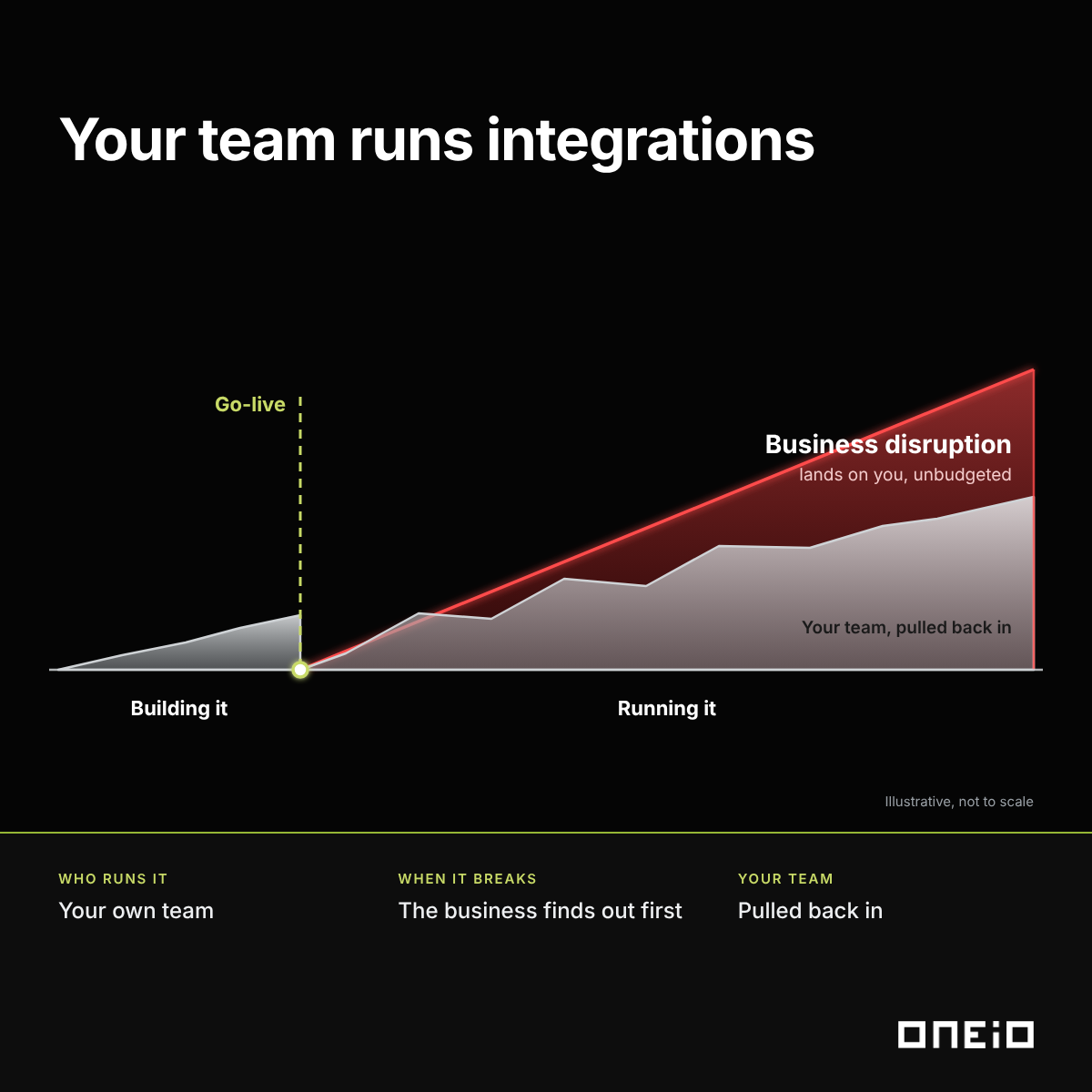
The difference from buying an integration platform is who does the work after go-live. Building an integration is the part everyone plans for. Running it is the part that never ends, and it is where the damage lands when something breaks.
When your team runs the integrations, every change in a connected system and every failed flow pulls people back in, often after the business has already noticed. The damage is far larger than the effort. In research by Arion Research for ONEiO, which surveyed 451 business leaders in three countries in October 2026, the team's own time to diagnose and fix an incident was about 2% of its all-in cost, and outside help such as contractors, emergency vendor fees and overtime about 43%. The other 55% was business impact: lost revenue, contractual penalties, delayed launches and lost productivity. The business loses more than 25 times what the team spends in its own time.
Handing the integrations to a provider does not make breaks disappear, and with most providers a break is still worked by people. What it costs then depends on three things: how many people it takes to fix, how long it runs from the moment it starts, noticed or not, to the moment it is fixed, and how many further disruptions it sets off along the way. The research shows the weight of each. 25% of organisations spent more than 100 person-hours on a single incident, 51% took a day or more to restore their worst one, and a failure that reached five or more areas of the business cost a median €196,000, about twice the €96,000 of one that stayed contained.
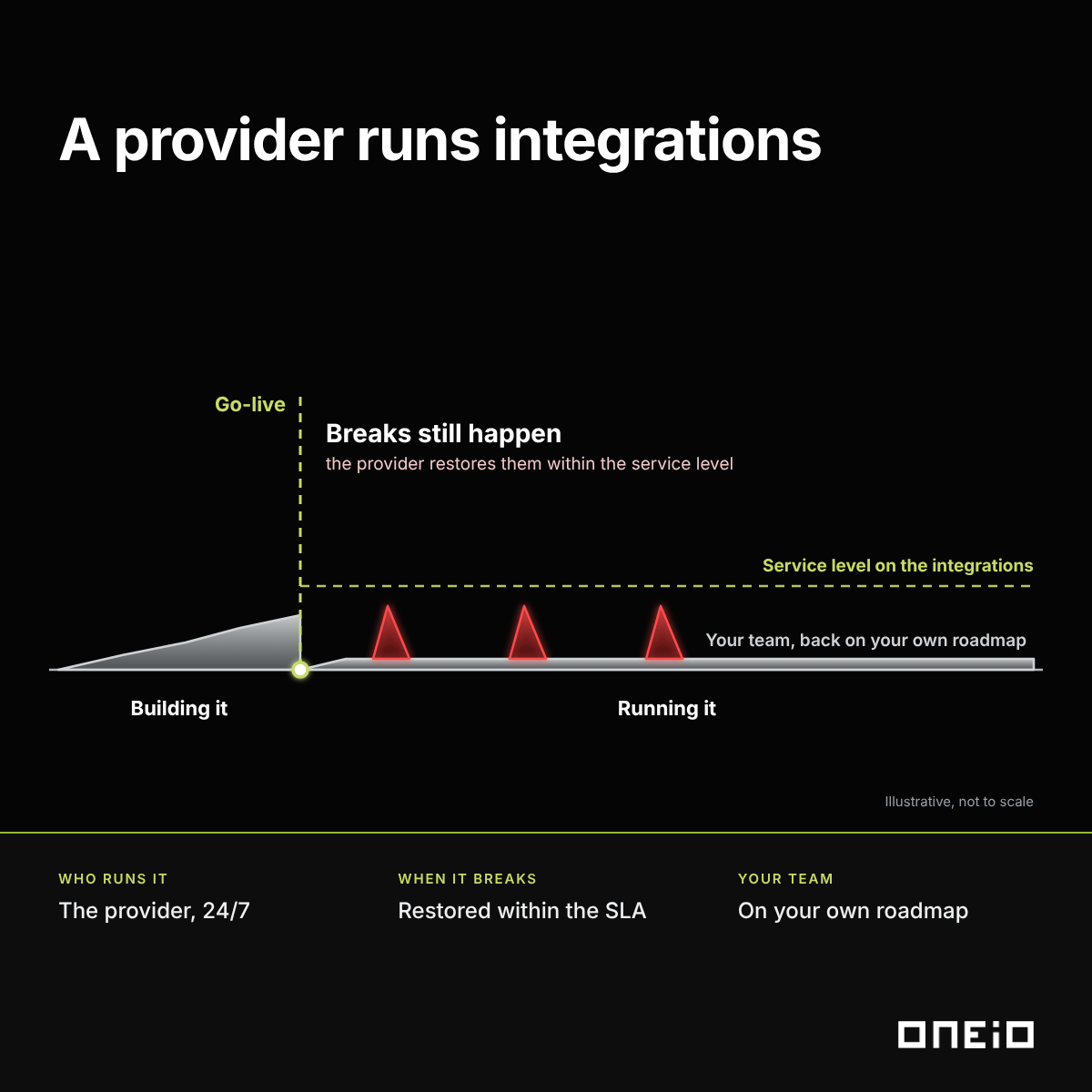
How the integrations are run makes a measurable difference. In the same research, organisations whose integrations were operated by a managed integration service were far less likely to face frequent disruption: 38% had four or more business-disrupting failures in a year, against 63% of those relying on vendor-supplied connectors or projects delivered by systems integrators. The open question is how much of that outcome each provider is willing to put in a contract.
Our comparison of system integrators, iPaaS consultants and managed integration services covers the three operating models in depth.
How we evaluated the providers
We used five criteria that apply to any estate:
- Who operates the integrations day to day. The provider, your team, or a mix.
- What the service level covers. Platform availability, response times, or the integrations themselves working.
- Who is accountable between vendors. When a flow fails between two systems owned by different parties, who restores it.
- How cost behaves as connections grow. Per connection, per transaction, per platform, or by the scope of the estate.
- How change is absorbed. Whether upgrades and changes in connected systems are part of the service or a new piece of work.
Each provider below is described in its own words, from its own website or reliable third-party assessments. Where a provider does not state a service level or a pricing model, we say so.
Operated integration services
An operated integration service runs the integrations as its core product. It operates the platform and the integrations, and keeping them running is the whole job.
1. ONEiO
ONEiO provides managed integrations for organisations that refuse to compromise on commitments. Its offering, ONEiO Managed Integrations, combines ONEiO's own Integration Ops Platform with the team that runs it, sold as a service. Its own description is short: "ONEiO runs your integrations. You deliver your services." ONEiO says it "operates the complete integration lifecycle" and that "each system connects once to ONEiO instead of relying on fragile point-to-point scripts." Operations run 24/7, with "SLA-backed service commitments and continuous operational responsibility."
What stands out: the service level is written against the integrations, not only the platform, and changes in connected systems are absorbed as part of the service. The platform is built to prevent breaks in the first place and, when one happens, to keep the people, the time and the knock-on disruption as small as possible. ONEiO is strongest where integration complexity is high. Information goes back and forth across in-house, customer, partner and supplier systems, the landscape never stops changing and failure is expensive.
Who operates the integrations: ONEiO, 24/7. Pricing shape: subscription, with the scope of the estate as the main variable.
Best for: organisations that need to say yes to every integration demand and break nothing.
ONEiO through its partners
You do not have to buy ONEiO directly. ONEiO works with a network of partners who "deliver ONEiO-backed integration capability to their clients", so the managed integrations can come as part of a service you already buy from an IT service provider or consultancy. The network includes Tietoevry and VisionWillow in the Nordics, Atos, CGI and Sofigate across Europe, Fujitsu in EMEIA, Novosco in the UK, and Blueponte, ServiceDesk24, Accompio and Exccon in the German-speaking markets, among others. If one of them already runs your service management, ask whether ONEiO can carry your integrations under the same contract.
B2B and EDI managed services
These providers operate trading-partner connectivity: EDI, document exchange and partner onboarding.
2. OpenText B2B Integration Enterprise
OpenText describes its service as "a trusted, fully managed, cloud-based platform for streamlined EDI services", "built on a global network of over one million pre-connected trading partners."
What stands out: the scale of the trading-partner network, which suits organisations whose integrations are mostly document exchange with external partners. Who operates the integrations: OpenText. Service level and pricing: not stated on the page.
Best for: enterprises outsourcing EDI and B2B trading-partner connectivity at scale.
3. IBM Sterling B2B Integration SaaS, Premium edition
In IBM's Premium edition, "IBM mapping experts handle all data integration and translation tasks", with "reliable SLAs and dedicated technical experts."
What stands out: IBM takes over the mapping work that in-house EDI teams usually carry. Who operates the integrations: IBM's mapping experts. Service level: "reliable SLAs", with no specific terms listed. Pricing: not stated.
Best for: organisations without in-house EDI or API skills that want IBM to run B2B onboarding and mapping.
4. Cleo Managed EDI
Cleo's managed service "gives teams expert help operating B2B integrations", with Cleo expertise available "for implementation, operations, partner onboarding, and ongoing support."
What stands out: customers choose fully managed, blended or self-service operation on Cleo Integration Cloud, so the split of work can change over time. Who operates the integrations: Cleo, shared, or your team. Service level and pricing: not stated.
Best for: B2B and EDI teams that want to choose how much of the operation to hand over.
Global system integrators: integration in a wider scope of work
The large SIs appear on almost every list of managed integration providers, and AI answers name them often. Their scope of work is different. Integration usually arrives as one part of a broader application, cloud or transformation contract, built on a platform the SI selects or a platform you already own. Their own pages describe build-and-run models, but none of the pages we reviewed states integration-specific service level terms. For a wider view of the firms in this group, see our list of top global system integrator companies.
5. Accenture Cloud Integration Services
In its UK government Digital Marketplace listing, Accenture says its Shared Service Delivery "encompasses all offerings associated with the provision of a live service" and offers "an industry leading 24x7 support capability." Service levels depend on "the client requirements and agreed 'response' service level agreement (SLA)."
What stands out: 24x7 support delivered as part of a wider Accenture programme. Who operates the integrations: Accenture. Service level: agreed per client. Pricing: not stated.
Best for: enterprises that want cloud integration delivered and supported inside a wider Accenture programme.
6. Deloitte Cloud Integration Services
Deloitte's Digital Marketplace listing includes "operating and evolving an integration platform and/or capability" among its features. Support "is typically available during working hours (Monday to Friday)", with out-of-hours cover by agreement.
What stands out: an advisory-led model that builds and evolves an integration capability alongside a transformation. Who operates the integrations: Deloitte operates and evolves the capability. Service level: not stated, with support in working hours. Pricing: not stated.
Best for: organisations that want an advisor to design, operate and evolve an integration capability alongside a transformation.
7. HCLTech Digital Integration Services
HCLTech offers "one unified managed services umbrella covering design, deployment and ongoing support", "with HCLTech managing the platform so you can scale confidently," across several integration platforms including Boomi, Workato, IBM, SnapLogic, Software AG and TIBCO.
What stands out: one partner across several iPaaS platforms. Who operates the integrations: HCLTech manages the platform. Service level and pricing: not stated.
Best for: enterprises that want one SI to design, deploy and support integration across several platforms.
8. Infosys Integration-as-a-Service
The Infosys cloud practice "offers Integration-as-a-Service, a managed services model for hybrid cloud integration projects."
What stands out: integration framed as a managed service within hybrid cloud programmes. Who operates the integrations: Infosys. Service level and pricing: not stated.
Best for: hybrid cloud integration programmes delivered in a managed services model.
9. Wipro iPaaS
Wipro advises customers to "opt for a partner who can build, own and operate the integration platform", so the platform "does not need any administration such as patch upgrades or log maintenance to be performed by the customer." Its integration-as-a-service material mentions "pay-as-you-go pricing".
What stands out: Wipro takes over platform administration, including patching and log maintenance. Who operates the integrations: Wipro builds, owns and operates the platform. Service level: not stated. Pricing: pay-as-you-go.
Best for: enterprises that want a partner to build, own and operate the integration platform.
10. Cognizant Enterprise Platform Integration
Cognizant "designs, builds, implements and runs enterprise integration platforms."
What stands out: build and run of a consolidated integration platform with one partner. Who operates the integrations: Cognizant runs the platform. Service level and pricing: not stated.
Best for: enterprises consolidating onto one integration platform with a single partner across build and run.
11. Capgemini AI-Powered Integration and APIs
Capgemini offers to "design, build, operate, and govern modern integration ecosystems", with AI-Ops for "intelligent monitoring, predictive operations, automated incident management."
What stands out: AI-Ops for monitoring and incident handling as part of the operating model. Who operates the integrations: Capgemini, with AI-Ops. Service level and pricing: not stated.
Best for: integration estates where AI-driven monitoring and operations are a priority.
Managed integration service providers compared
When ONEiO is not the right choice
We would rather you pick the right provider than the wrong ONEiO contract. ONEiO is not the best fit in these situations:
- Your integration estate is mostly EDI with a large trading-partner network. Specialist B2B networks such as OpenText, IBM Sterling or Cleo are built for that.
- You have standardised on one iPaaS and want a partner to run it. A certified partner for that platform keeps you on the platform you chose.
- Integration is part of a wider transformation programme. If an SI is already delivering the programme, adding integration to its scope can be simpler.
- Your estate is small and stable. A handful of integrations between systems that rarely change does not justify an operated service.
- Integration is your product. If the way you connect to customers is a differentiator you sell on, keep the capability in-house and buy a good platform. Our iPaaS solution shortlist is a place to start.
- You need a one-time migration. A move with a defined end state is project work. See alternatives to system integrators for when the project model fits and when it does not.
ONEiO earns its place where integration complexity is high, where the systems on both sides change constantly, and where a lot is at stake when integrations fail.
How to choose a managed integration service provider
Start with the model, then the provider. Decide whether you need trading-partner connectivity, an SI to fold integration into a wider programme, or a provider that operates the integrations themselves, bought directly or through a partner you already work with.
Then ask every shortlisted provider the same questions, and get the answers in writing:
- Who monitors our integrations, and at what hours?
- Does your service level cover the integrations working, or the platform being available?
- When a flow fails between two vendors, who restores it, and how is that written in the contract?
- What happens, and what does it cost, when one of our connected systems is upgraded?
- How does the price change when we add customers, partners or systems?
- What do we keep, and what can we take with us if we leave?
If you are moving from a self-run iPaaS, our guide to moving integration operations to a managed service sets out the phases and who owns what. For how the managed model differs from iPaaS, see what is managed iPaaS.
Bottom line on managed integration service providers
The providers in this list are all credible, and they are not interchangeable. The model decides more than the brand: B2B networks run trading-partner connectivity, SIs run integration inside a wider contract, and operated services like ONEiO run the integrations themselves.
Whichever you choose, ask what the service level actually covers and who restores service when a failure sits between two vendors.
Owning the stack was never the same as owning the outcome.
Compare ONEiO against your shortlist. Schedule a 30-minute conversation and we will answer the six questions above for your estate.