

The business wants AI agents in production, and IT is expected to say yes and break nothing while doing it. The usual AI readiness assessment backs that yes with scores for strategy, data, infrastructure, skills and governance.
What those scores leave out is the layer an agent acts through. Before an agent can resolve a ticket, update an order or reroute a shipment, the systems involved have to be connected, and the connections have to keep working while everything around them changes.
Key takeaways
- AI readiness frameworks check strategy, data, infrastructure, skills and governance. Few of them check the integrations that move data between systems and carry an agent's actions into them.
- Data readiness depends on integration readiness. Data that has to be centralised, kept current and written back reaches the AI through integrations, and Cisco found that 64% of organisations struggle to centralise data.
- AI speeds up whatever state your integrations are in. Broken or unowned integrations fail faster and more visibly once agents act on them.
- An integration readiness check asks seven things: do you know every integration, does each have an owner with time, do you detect failures on business outcomes, do integrations absorb change, can agents act safely across systems, what is at stake when they act on bad data, and who restores service at any hour.
- You do not have to fix the whole estate first. Fix the integrations under your first AI use case before scaling it; that decides whether saying yes to the next one is safe.
The operating discipline behind this. The Integration Ops book sets out how Managed Integration Services run and measure integrations over their whole life. Download the book.

What is AI readiness?
AI readiness is an organisation's ability to put AI and AI agents into production and keep them working safely. It covers a clear use case, data the AI can trust, infrastructure, skills and governance, and the integrations that move data between systems and let agents act on them. Most readiness frameworks cover the first five and leave out the last.
Why most readiness frameworks miss the integration layer
The readiness frameworks that rank in search today look at data where it sits, mainly its quality and its governance. The evidence says that is where many organisations are stuck. Gartner reported in February 2025 that 63% of organisations either do not have or are unsure if they have the right data management practices for AI, and predicted that through 2026 organisations will abandon 60% of AI projects unsupported by AI-ready data.
Cisco's AI Readiness Index points at the same weakness from another side. Of the 8,000 senior IT and business leaders it surveyed, 64% struggle to centralise data, 83% plan to deploy AI agents, and only about 13% qualify as fully prepared "Pacesetters". Cisco's own summary is that "AI agents are exposing weak foundations."
Centralising data is an integration problem before it is a data problem. Records have to move from the systems that create them, stay current as those systems change, and, once agents act, travel back into the systems where the work gets done. A readiness score that rates the data warehouse and never asks how the data gets there misses the part that breaks most often in production. We explain why agents stall at that write path in AIOps integration.
AI amplifies the state your integrations are in
Jaro Tomik is the founder of Buvalo and a former chief technologist in enterprise IT. He describes what happens when AI meets an existing estate.
"AI, because it speeds things up ultimately, it amplifies. So whether it's good data, bad data, anything in between, it will amplify it. Your processes, your people skills, the data that you have access to, not have access to, your lack of integrations, or the quality of them, it will highlight it all and it will go at a faster pace."
Jaro Tomik, Buvalo
The estate an agent lands on is already breaking, and mostly not through anyone's neglect. Research by Arion Research for ONEiO, which surveyed 451 business leaders in three countries in October 2026, found that 75% of organisations trace their integration disruptions to a change made outside their own walls, such as a vendor changing an API, a forced upgrade or a partner changing its systems. Demand is not slowing either: 87% say demand for new integrations is growing, and 77% say existing integrations need frequent changes.
Agents change how quickly a broken integration turns into a business problem. Only 19% of the leaders in the same research first learned of their worst integration failure from an automated alert; for most, the first sign was data that was missing, wrong or out of date. A person spots bad data, eventually, and asks. An agent acts on it, at machine speed. Roy Illsley, an analyst at Omdia, expects agentic AI on an unprepared estate to fail "very, very quickly and very, very badly."
The platforms are opening up faster than the estates behind them. On 5 May 2026 ServiceNow made its Model Context Protocol Server generally available, opening its platform "to any AI agent". At ONEiO's Breakfast & Learn in Helsinki in September 2026, ONEiO CEO Juha Berghäll made the same point to a room of IT leaders. Every software vendor is shipping agents into its own product, on its own schedule, and none of those agents work without live connections to your systems and data. That turns the integration layer into critical infrastructure. His summary of where the work now sits: "Connecting an agent is 'solved'. Operating the connectivity is not." Our article on AI agent integration covers what changes in the integration layer once agents arrive, and what ServiceNow AI agents can and cannot do outside ServiceNow shows where that reach stops in one platform.
What is at stake when an agent acts on a broken integration
An agent working from an integration that has stopped delivering the right data does not stop. It closes tickets that are still open at the customer's end, reorders stock that already arrived, promises delivery dates the warehouse system no longer holds, or sends invoices built on old prices. Each of those lands outside IT: service level penalties, disputes that hold up cash, write-offs, customers who stop trusting the answers they get, and audit findings when nobody can show what the agent saw before it acted. Gartner expects this to become common: by 2028, 40% of infrastructure and operations organisations running agentic AI at scale in production will experience a business-critical service disruption, up from less than 1% in 2026, as reported by The Register.
The cost of running the integrations can be budgeted. The disruption when they fail is the larger number. In the Arion Research survey, the worst integration incident of the year cost a median €136,000 all in, and 55% of that was business impact such as lost revenue, penalties and lost productivity. Under an agent, that number grows with every system the agent is allowed to touch. We break down the budgeting side in AI integration costs.
Accountability does not move to the agent. Roy Illsley puts the governance point plainly.
"You can't have agentic AI being accountable for agentic AI. Agentic AI is not accountable. It's not in the RACI model... a human has to be accountable for that action of that agent."
Roy Illsley, Omdia
When the action crosses systems, that human needs to know which integration carried it and who keeps that integration working. Without both, nobody can explain the action to an auditor or a customer.
The integration readiness checklist
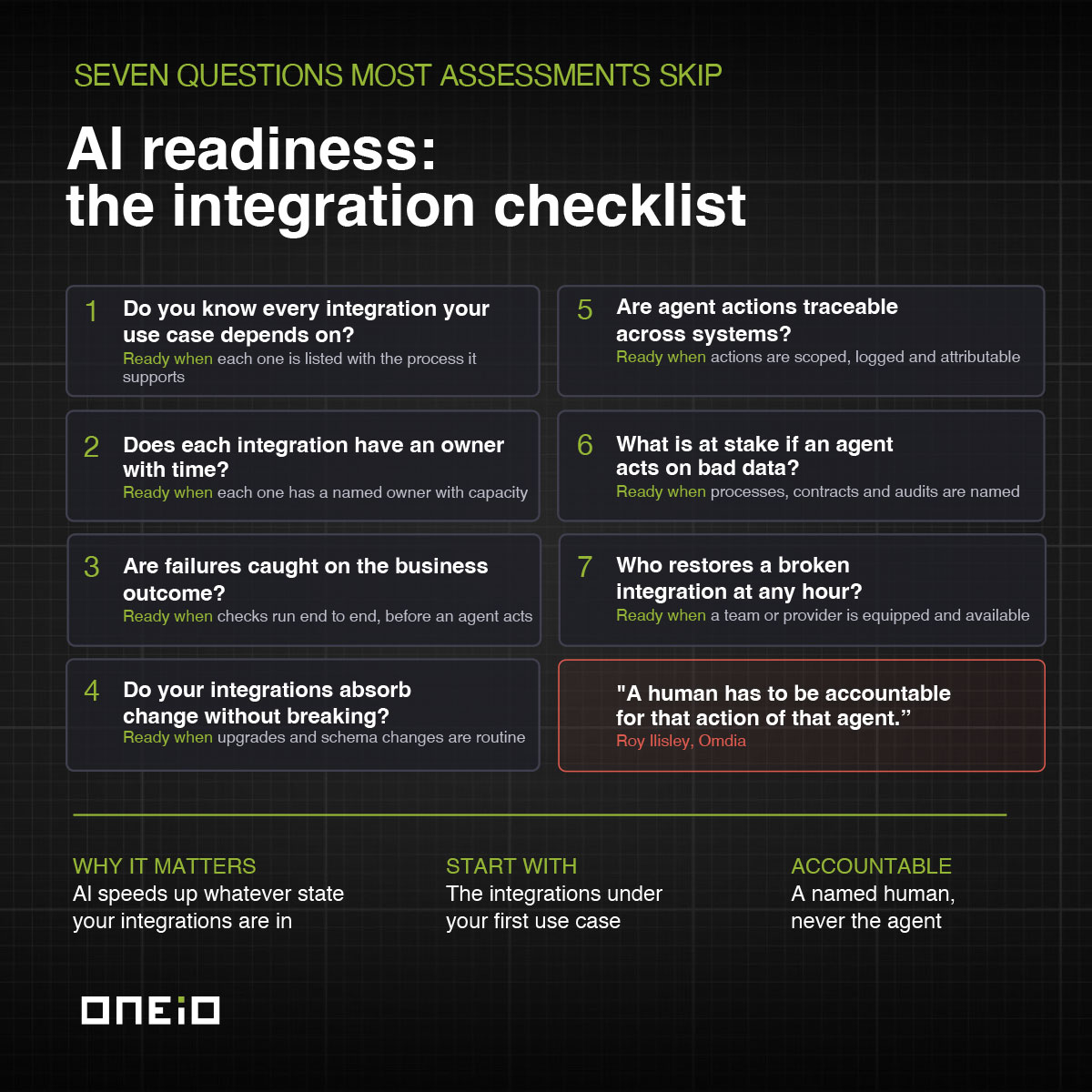
1. Do you know every integration your AI use case depends on?
Ready means a current list of every integration the use case touches, with the business process each one supports and the systems at both ends. In most estates nobody keeps the complete list, and integrations delivered by past projects are the ones most often missing. For ServiceNow estates, ONEiO's free Integration Ops app lists every integration in the instance with its owner and health.
2. Does each integration have an owner with the time to look after it?
You need a named owner who knows what the integration does for the business and has capacity to keep it working. A name on a list does not count if that person spends the week on other projects.
3. Do you detect failures on the business outcome, before an agent acts?
The test is monitoring that checks whether the record arrived complete and correct at the other end, across both systems, around the clock. Interface status alone reports success while the process behind it has stopped, and an agent will act on whatever it finds.
4. Do your integrations absorb change without breaking?
Upgrades and schema changes at either end should be routine, without breaking the flows that agents rely on. Decoupled integrations, where each system connects once, keep a change on one side from cascading into every connected system. Modernising IT services without breaking your integrations covers what typically breaks.
5. Can agents act across systems safely, and is every action traceable?
Every agent action that leaves its home platform should pass through an integration that is permission-scoped, logged and attributable, so an auditor can see what the agent changed, where and on whose authority, and so the action meets the legal and regulatory requirements of the data it touches. ServiceNow, for example, runs actions through its own AI Control Tower so they are "identity-verified, permission-scoped, and fully auditable" inside the platform. The integrations that carry those actions into SAP or a supplier's system need the same standard.
6. What is at stake if an agent acts on stale or missing data?
Name the processes the use case touches, who notices first when it goes wrong, how long a manual workaround holds, and which contracts, service levels or audits depend on it. The answer sets how much integration risk the use case can carry.
7. Who restores a broken integration at agent speed, at any hour?
A named team or provider has to be equipped, staffed and available to restore service before the business damage builds, including when the failure sits between two vendors. If the honest answer is "whoever is on call works it out", the use case is not ready, however good the model is.
How much of your estate must you fix before AI is safe?
Less than most programmes assume. A fix-the-estate-first programme does not make AI safe, because the estate keeps changing underneath it while the work goes on. Most of that change is made by vendors and partners, and it will keep arriving after the programme ends.
Start with the use case instead. Michael Manea, VP Global Business Services at All for One, hears the same opening request from customers: "Why don't we just buy an AI license, which is doing everything for us?" After that question, in his experience, "most of the customers do not know what they really want." A specific use case with a named business outcome tells you which integrations matter.
Then fix the integrations under that use case before scaling it. Inventory them, give each one a resourced owner, put outcome monitoring on them and agree who restores them. That work is smaller than an estate-wide programme, and it is what makes the second and third use cases faster to approve.
Time matters here. Jaro Tomik points to the clock most CIOs work against: with "an average lifetime of a CIO in a company of 18 months," he says, "you've got 18 months to make the right decisions." Teams that spend that time firefighting integrations will not have it for AI. Our article on freeing IT team capacity for AI development covers where that capacity is held today.
Where Managed Integration Services fit
The Integration Ops book puts the relationship in one line: "Integration Ops provides the structure; AI provides acceleration." Managed Integration Services are one way to get the structure without building it in-house first. You keep the AI strategy, the governance and the knowledge of your own systems and processes. What is taken care of is building the integrations your use cases need and running them 24/7, keeping them operational through outages, upgrades and migrations, and meeting the service levels and audits that depend on them. Each system connects once, so adding an agent or a new platform does not add complexity to the systems you already run. ONEiO Managed Integrations works this way, with a service level on the integrations themselves, so IT can say yes to the next AI use case without betting the existing processes on it.
The reason to change the model now is speed. In the traditional set-up, people plan, implement, monitor, operate and change every integration, so the only way to keep up with more demand is to add people. Agents create demand at machine speed, and no hiring plan closes that gap. As Juha Berghäll put it in Helsinki, a tool plus people no longer keeps up. In ONEiO's model, machines run the operation and people carry the judgement and the accountability.
Bottom line on AI readiness
AI readiness is usually measured on strategy and data. The integrations between systems decide whether any of that reaches production safely, because data moves through them and agents act through them. AI will speed up whatever state those integrations are in.
Before you scale an AI use case, check the integrations under it: whether you know them all, whether each has an owner with time, whether failures are caught on business outcomes, whether they absorb change, whether agent actions are traceable, what is at stake when they fail, and who restores them at any hour. Whether you build that capability in-house or run it as a service depends on how much is at stake and how realistically your team can be there when it breaks.
Saying yes shouldn't be the thing that breaks you.
Check the integrations under your first AI use case. Schedule a 30-minute conversation with an integration specialist and map which connections your agents will depend on.