

Most enterprise integration strategies were built for a smaller problem than the one you're solving now. More tools, more vendors, more handoffs across business and IT — and the integrations holding it all together are expected to keep up. They don't. Projects run long. Budgets drift. Connections break in production and quietly drain the teams meant to be delivering services.
Integration as a Service (IaaS) is a different operating model. A provider owns the integrations end-to-end — design, delivery, monitoring, and the running. You buy the outcome, not the labour. New tools get added without new headcount. Old integrations stay running without a war room.
This guide is for people deciding whether IaaS is the right model for their organisation. By the end you'll know:
- What IaaS is, and how it differs from point-to-point, iPaaS, and ESB.
- Who it's built for — and the kinds of organisations that get the most out of it.
- The trade-offs of every common integration approach, side by side.
- How IaaS is priced, and why outcome-based pricing changes the maths.
- What a credible integration service provider actually does — and how to tell one apart from a middleman.
- What ONEiO's integration landscape assessment looks like, if you want to test the model on your own estate.
Key takeaways
- IaaS removes the burden of platform ownership, capital investment, and infrastructure management.
- Managed integration services shorten time to value, reduce implementation risk, and make operating costs predictable.
- IaaS providers own the design, deployment, monitoring, and optimisation. The customer focuses on outcomes.
- IaaS scales without headcount. New integrations don't mean new engineers.
- 2026 trends show steady IaaS adoption. Organisations are shifting from "build" to "subscribe".

What is Integration as a Service?
Integration as a Service (IaaS) is a delivery model. Customers — large enterprises or IT service providers — outsource integration projects to a provider that handles the detailed integration design and implementation. The provider links application functions and data, and embeds them into the existing IT infrastructure.
The model covers the full pipeline. Planning. Delivery. Maintenance. The provider owns the risk. The customer stops building and maintaining its own integrations and gets back to improving the services it sells.
The companies operating in this delivery model vary. More on that further down.
Who Integration as a Service is for
IaaS fits two profiles:
- Enterprises with enough integration needs to justify outsourcing — typically mature organisations with many moving parts, multiple sites, and entrenched legacy systems.
- IT service providers that have hit the wall trying to roll out and scale integrations for their customers' systems.
It also fits IT companies running the SIAM® approach — anyone managing the downstream effects of complex multisourcing. Outsourcing the integrations means outsourcing the risk. It also unlocks benefits no in-house alternative delivers.
The benefits of Integration as a Service
In-house teams can build integrations. They struggle to make the projects predictable. Long timelines. Unclear budgets. Heavy outsourcing. Bloated support contracts holding fragile connections together.
IaaS works differently. Three benefits matter most:
- Scalability — new integrations don't require more engineers.
- Repeatability — outcomes are consistent project to project. The one-off complications that wreck typical integration work disappear.
- Outcome-based pricing — the customer pays for the result.
A provider runs the whole service. Integration specialists diagnose and remove the choke points between services across the organisation. Ecosystem thinking is built in.
When integrations stop being a bottleneck, new products, features, and value reach employees and customers faster. That's the competitive edge. Integration projects stop being a tax on operations and start being an asset.
How Integration as a Service is priced
Like SaaS, IaaS moves integrations to a subscription model — not a one-off cost.
Today, integration projects are usually priced as packages. The price is shaped by:
- Time to implementation
- Staffing requirements
- Scope of the integration
- Tool and platform selection
- Maintenance and operating costs
Automation cuts the manual effort behind each integration. That cuts the cost of delivery. Providers can offer subscription pricing — customers pay for the outcome, not the labour behind it.
The other advantage: you only pay for what you use. Buying integrations as a service means buying the result, not the technical solution.
Business ecosystems run on integrations
Every business operates inside an ecosystem. Suppliers, customers, partners, vendors. Energy moves between them. Lifecycles overlap.
Gartner puts it directly in 8 dimensions of business ecosystems:
"Every organisation exists in multiple business ecosystems — dynamic networks of entities that interact with each other to create and exchange sustainable value for participants. The challenge is to determine how your business will survive and thrive in its ecosystem."
The same logic plays out inside the company. Each department is its own actor in a larger system. They interact. They deliver services. They contribute to a shared outcome. Gartner makes the same point in ecosystems drive digital growth.
Both levels matter. The ecosystem only works when the parts interact cleanly.
Take IT service management. A managed service provider handles tickets from multiple sub-departments inside a customer's organisation. If those entities can't work together — because the ecosystem is disconnected — tickets stall. No one has full visibility. SLAs slip.
Application integrations carry these interactions. Connect the tools, and you connect the teams. Connect the teams, and the services they deliver line up end-to-end. In ITSM, this is called service integration.
Common integration solutions
There are many ways to build integrations. Most are built for a specific scale, a specific tool, or a specific use case. The list isn't exhaustive, but these are the common ones for application integration:
- Point-to-point integrations
- Integration platform as a service (iPaaS)
- Enterprise information portals (EIP)
- Enterprise service bus (ESB)
- Outsourcing to an integration service provider (like ONEiO)
Most of these are implemented by IT specialists in-house. Each was designed under different assumptions, for different technology landscapes, with different problems in mind.
Outsourcing isn't a technology. It's a delivery model. And it's the one that addresses the structural problems integration projects keep running into — especially in established enterprises and IT service providers.
Pros and cons of common integration solutions
For a deeper comparison of the trade-offs — point-to-point, iPaaS, ESB, and IaaS — see our breakdowns of point-to-point vs Integration as a Service, iPaaS vs Integration as a Service, and ESB vs Integration as a Service.

The integrations companies actually need
A business has to reach a certain level of maturity before service integration becomes critical. But most modern companies already need a degree of system integration.
Common needs:
- An IT service organisation wants to enforce its ITSM tool across teams in a mature enterprise.
- An enterprise wants to centralise ticket management across multiple vendors using different tools — without forcing one system on all of them.
- An external IT service provider needs every system in the customer organisation to be governed by a single access control system on its side.
Connecting one tool to another is easy to understand. Companies that think in ecosystems go further. They look at integration strategy at the level of business operations — how departments, tools, and processes interact across internal teams and external partners.
Practical examples:
- A national retailer runs POS devices across hundreds of stores. The data flows to maintenance teams, head-office services, and IT — all in different systems, all needing the same picture.
- An aviation logistics company depends on continuous, reliable communication across systems and teams. Its IT organisation has to comply with the practices and processes of the airports and airlines it serves to keep service delivery reliable end-to-end.
- Large IT organisations are outsourcing to more vendors than ever. The multisourcing model, combined with cloud-first delivery, drives up admin cost, reduces control, and weakens visibility. Integrations are what hold the operating model together.
What is an integration service provider?
The companies operating the IaaS model are integration service providers. They sell integrations as a solution — packaged as a single connection, multiple connections, or an ongoing service.
Integration service providers exist to handle the problems companies keep running into:
- Knowledge and resource gaps — service integration projects are expensive, complex, and unpredictable.
- Technical capacity and complexity — integrations are manual work, and the technical depth required is significant.
- Accountability — staffing and clearing tasks across an integration project are hard to optimise.
- Lack of repeatable processes — every service integration is heavily customised. Standardising is almost impossible.
- Vulnerability — failed integrations cost data and break SLAs. Fixing broken integrations consumes critical resources.
Are all integration service providers the same?
No.
Some providers act as middlemen. They project-manage integrations and pass the work to teams that build them point-to-point. Others build on top of an iPaaS platform.
ONEiO does neither. We've built an integration automation platform on proprietary technology. The combination is current technology and years of operating in the ITSM domain.
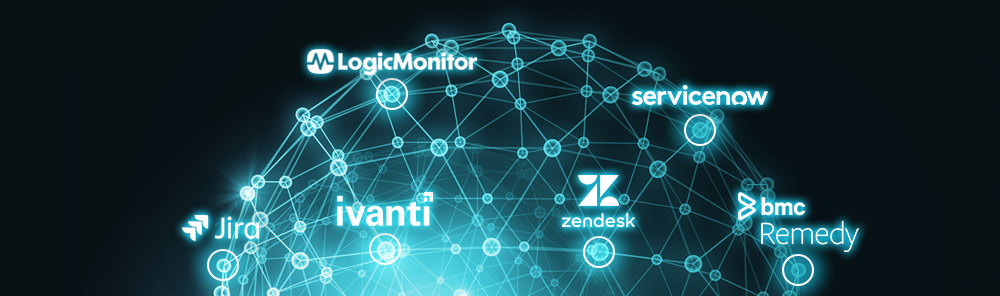
The platform delivers ready connectivity to the tools customers use most — ServiceNow, Zendesk, Jira. New tools are added in two weeks. The platform runs in the cloud and is built for continuous availability.
We don't only deliver integrations at scale through the cloud. We work alongside enterprises and IT service providers to identify service integration opportunities across their organisations.
Our lifecycle is consistent:
- We map the service delivery landscape with you. We identify the systems and processes that need to communicate.
- We prioritise the integrations that have the most impact. That gets the ecosystem moving.
- We automate the communication using our rule engine. Rules are set on the processing logic we've agreed on.
- The result is a fully integrated ecosystem with real-time monitoring. New tools and services slot in. They work with the existing systems out of the box.
The integration landscape assessment
Integration service providers diagnose process blockers across the ecosystem — internal teams, external partners, both. At ONEiO, this starts with an integration landscape assessment.
In the assessment, our specialists work with the customer to find how, together, we can:
- Remove repetitive manual work.
- Improve and reuse existing automation workflows and integrations.
- Align IT to business needs.
- Help IT support core business functions better.
- Build an integration roadmap.
- Benchmark integration strategy against other organisations.
- Quantify the cost savings and ROI integrations deliver.
The work unlocks the profit potential trapped inside inefficient processes. The outcome is a healthier business ecosystem.
Betreiben Sie Integrationen wie einen laufenden Betrieb. Nicht wie ein Projekt. Vereinbaren Sie ein Einführungsgespräch mit den ONEiO Managed-Integration-Spezialisten.