

Modern businesses run on cloud applications. According to ONEiO's State of Integration Solutions research, the average enterprise organization uses over 100 SaaS apps, with large enterprises managing 250-500+ applications.
Connecting different cloud applications together has created an entire category of enterprise software. With over 900 integration platforms tracked by software comparison websites like G2 and Capterra, choosing the right solution requires careful evaluation.
This article examines the best-fit solutions for enterprise IT service management heading into 2026 based on serving hundreds of enterprise customers with their cloud integration needs.
What are cloud integration platforms?
A cloud integration platform is a service or software that connects different applications, APIs, data sources, and processes via cloud cloud computing. These platforms typically provide pre-built connectors, visual workflow builders, and management tools to move and synchronize data across systems in real time.
Cloud-based integration platforms eliminate manual and error-prone data integrations. When implemented effectively, they ensure information flows smoothly between SaaS apps, databases, and legacy IT systems.
Top 10 cloud integration platforms comparison
The table below summarizes key features, pricing models, and differentiators for the top 10 platforms serving ITSM and enterprise integration needs.
ONEiO
ONEiO is a managed iPaaS: a Managed Integration Service that delivers the outcomes of an iPaaS, connected systems, monitored flows and SLA-backed uptime, without the customer operating the platform. ONEiO designs, runs, monitors and maintains the integrations end to end. Self-service iPaaS is a platform you buy and operate. Managed iPaaS delivers the same integration outcomes, with the provider operating them. The capability is the same. The difference is who operates it.
HQ:
Helsinki, Finland
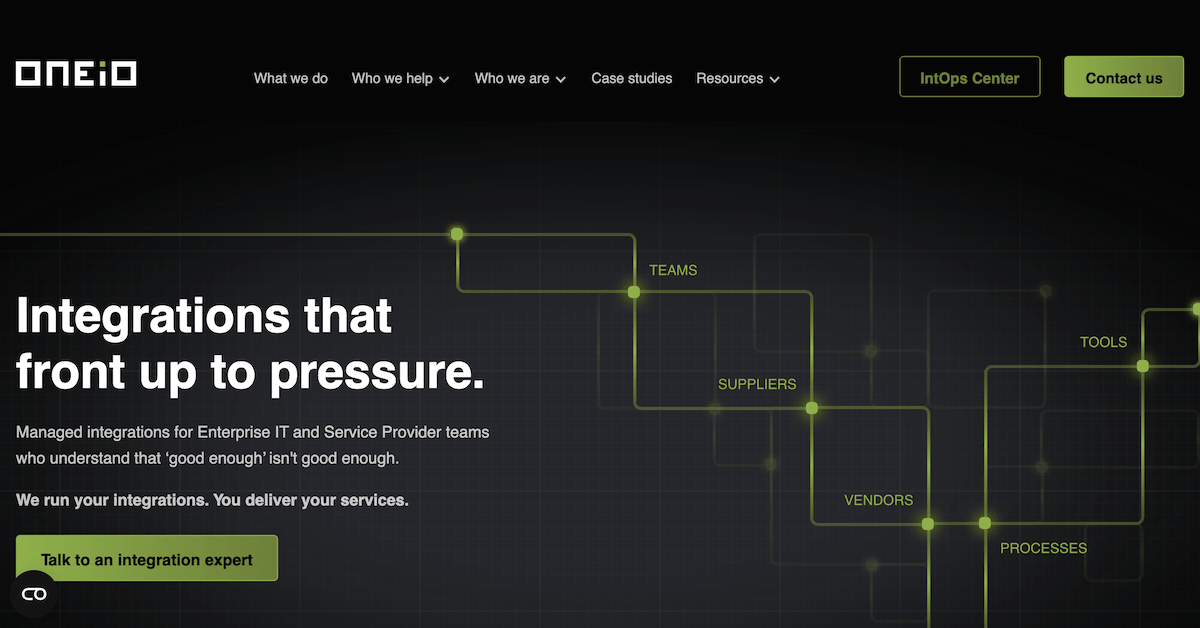
ONEiO connects each system once to a shared integration layer instead of building point-to-point connections, so tools can be replaced and ecosystems can grow without integrations breaking. Delivery is standardised and priced as a subscription, either volume-based or fixed per integration, which keeps cost predictable. ONEiO has deep domain expertise in ITSM, managed service provider and B2B eBonding scenarios, where the same incident, request or change record has to stay consistent across organisations that do not share a service desk. Most integration vendors build it and hand it back. ONEiO takes operational ownership permanently, and customers decide how much control they keep. Choose ONEiO when you want integration outcomes without staffing an integration team. Choose a self-service iPaaS when you have mature in-house integration engineering and want maximum platform control. ONEiO designs, runs and maintains the integrations, 24/7 under SLA.
Overall rating



Customer support rating
Pros:
- Fully managed and SLA-backed. ONEiO runs the complete integration lifecycle, from design and deployment through 24/7 monitoring and maintenance, so reliable integrations do not require an in-house integration team.
- Built for complex, changing environments. Each system connects once to ONEiO instead of point-to-point builds, with deep domain expertise in ITSM, MSP and B2B eBonding scenarios.
- Predictable cost and fast delivery. Fixed subscription pricing, volume-based or per integration, with standardised delivery in weeks rather than months.
Cons:
- Not a self-service platform. If you have a mature integration team and want hands-on platform control, a self-service iPaaS gives you more of it.
- No full API management suite. ONEiO is not designed for API productisation such as gateways, developer portals or API monetisation.
- Cloud-only. On-premise systems can be integrated, but ONEiO itself cannot be deployed on-premise, which is a constraint for air-gapped or strict data-residency environments.
SnapLogic
SnapLogic is a self-service low-code integration platform for building data and application pipelines through a visual interface. Since 2026 it positions itself as an agentic integration company.
HQ:
San Mateo, California
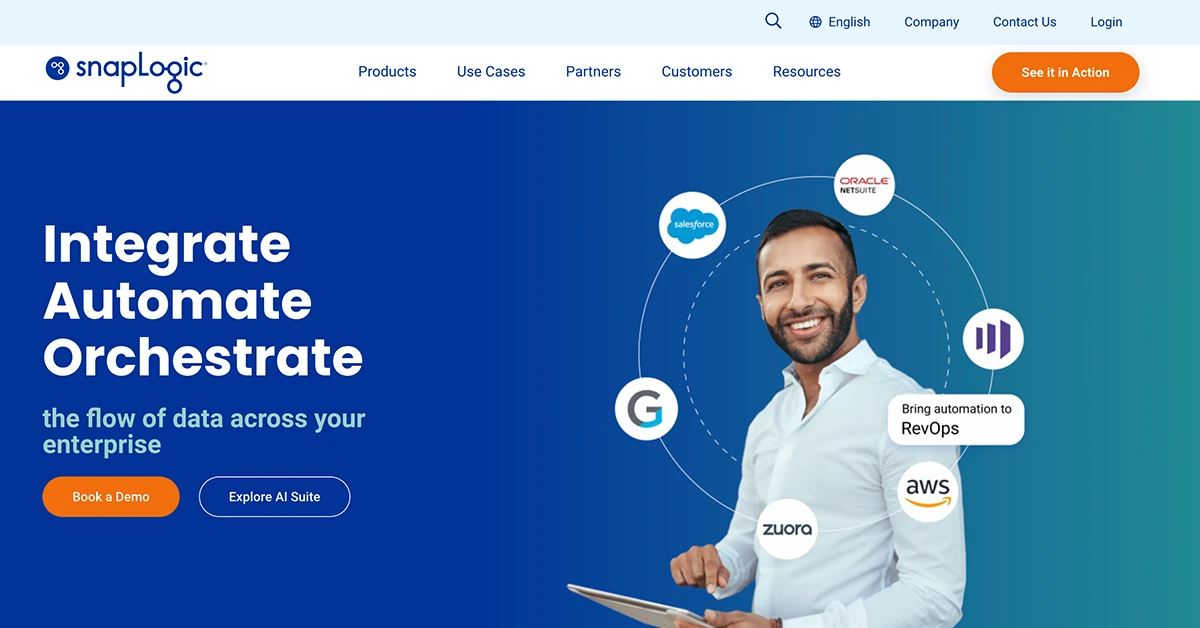
The SnapLogic Intelligent Integration Platform uses a drag-and-drop pipeline builder with a large library of pre-built connectors called Snaps, covering ETL-style data integration, real-time application integration and API creation with minimal coding. In July 2026 SnapLogic relaunched SnapGPT as an agentic assistant covering the whole integration lifecycle, from building and testing pipelines to documenting and troubleshooting them, alongside an AI Gateway and Trusted Agent Identity for governing what agents are allowed to reach. B2B and EDI capability remains modest. Your team designs, runs and maintains the pipelines.
Overall rating
Customer support rating
Pros:
- Visual pipeline builder that is quick to learn for common patterns.
- Transparent pricing and presence on the major cloud marketplaces.
- SnapGPT now spans the full integration lifecycle rather than pipeline generation alone.
Cons:
- Limited B2B and EDI capability.
- Coarse access permissions for larger teams.
- Debugging and advanced use carry a real learning curve.
Celigo
Celigo is a self-service iPaaS focused on SaaS integration and back-office process automation, aimed mainly at mid-market and upper-midmarket companies.
HQ:
Redwood City, California
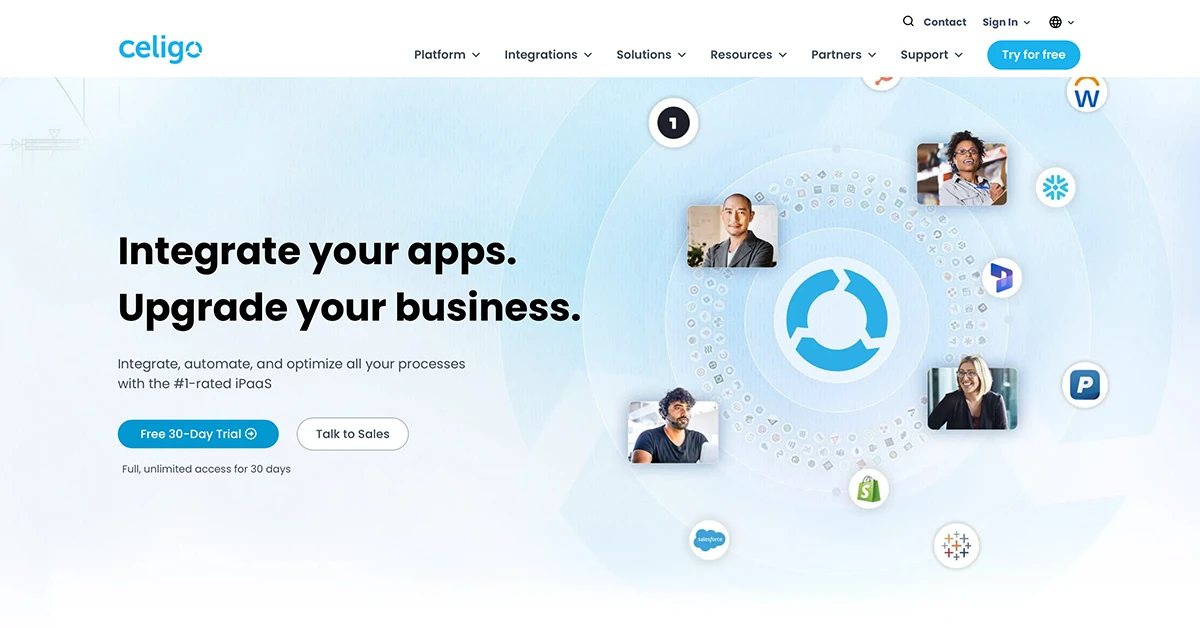
The Celigo integrator.io platform combines a large library of business-process templates with automated error handling, and is strongest in finance, e-commerce and NetSuite-centred back-office work. In March 2026 Celigo launched Ora, a natural-language copilot, together with Agent Builder, which lets business teams build and govern AI agents on top of existing integrations. B2B integration and developer experience are the stated roadmap priorities. Celigo suits teams that want business users building automations with IT oversight. Your team designs, runs and maintains the integrations.
Overall rating
Customer support rating
Pros:
- AI-assisted categorisation and resolution of runtime errors.
- Large library of business-process templates, strongest in NetSuite and e-commerce.
- Ora and Agent Builder let non-developers build governed AI agents.
Cons:
- Fewer enterprise controls at large scale.
- Operational data is difficult to export to external monitoring tools.
- Interface complexity grows quickly beyond template-based use.
TIBCO
TIBCO has a long legacy in enterprise integration and messaging, and is known for powering mission-critical, high-throughput systems. It has been part of Cloud Software Group since 2022.
HQ:
Santa Clara, California
The TIBCO Platform brings integration, messaging, API management and data products together for organisations running high-volume, latency-sensitive workloads, often in financial services, telecoms and logistics. TIBCO has been part of Cloud Software Group since the 2022 combination with Citrix. Its 2026 AI work centres on adding model and agent capability into existing BusinessWorks flows rather than launching a separate agent platform, which suits customers protecting a large installed estate. TIBCO fits data-centric integration strategies in enterprises that already run TIBCO. Your team designs, runs and maintains the integrations.
Overall rating
Customer support rating
Pros:
- Proven at very high message volumes and low latency.
- Wide range of integration styles within one portfolio.
- Volume-based pricing that flexes with usage.
Cons:
- Inconsistent experience across a portfolio assembled over many years.
- Some capability is available only self-hosted.
- Slower release cadence than the cloud-native vendors.
IBM App Connect
IBM App Connect is an enterprise integration platform for connecting applications, automating workflows and synchronising data across hybrid cloud environments.
HQ:
Armonk, New York
App Connect combines AI-assisted mapping and transformation with hybrid deployment, so legacy systems and cloud applications can be connected from one platform. It includes API management and an event-driven architecture for real-time synchronisation, and it sits inside IBM automation portfolio alongside webMethods, which IBM acquired from Software AG in 2024. It is most compelling for organisations already committed to IBM middleware. Your team designs, runs and maintains the integrations.
Overall rating
Customer support rating
Pros:
- Strong hybrid and on-premise deployment options.
- Built-in API management and security controls.
- Fits organisations already running IBM middleware and automation tooling.
Cons:
- Steep learning curve for teams without IBM experience.
- Portfolio overlap with webMethods makes the roadmap harder to read.
- Some customers report licensing is complex to model.
Oracle Integration Cloud
Oracle Integration Cloud is an iPaaS for connecting Oracle and third-party applications, with prebuilt adapters and process automation.
HQ:
Austin, Texas
Oracle Integration Cloud combines a visual integration designer, prebuilt adapters for Oracle Fusion and third-party applications, and process automation in one service. Governance and security controls are built for regulated enterprise use, and Oracle is extending the platform with AI-assisted mapping and agent capability tied to its Fusion applications. It is a natural fit for organisations standardised on Oracle and a harder one to justify elsewhere. Your team designs, runs and maintains the integrations.
Overall rating
Customer support rating
Pros:
- Strong Oracle integration
- Enterprise-grade security
- Visual designer that reduces hand-coding for standard patterns.
Cons:
- Less flexible with non-Oracle tools
- Can become expensive at scale
- Smaller independent partner ecosystem than the market leaders.
SAP Integration Suite
SAP Integration Suite is the iPaaS component of SAP Business Technology Platform, built for integration within and around the SAP ecosystem.
HQ:
Walldorf, Germany
SAP Integration Suite covers application, data, API and B2B integration, with several thousand prepackaged integrations for SAP applications and a smaller set for third-party systems. SAP is aligning the suite with its business AI agents, using Business Technology Platform as the governed data and process layer those agents act through. The suite is a strong fit for organisations heavily invested in SAP and a harder one to justify elsewhere. Your team designs, runs and maintains the integrations.
Overall rating
Customer support rating
Pros:
- Thousands of templates, primarily for SAP applications.
- Global operational and support presence through SAP.
- Transparent pricing.
Cons:
- Perceived primarily as an SAP-centric tool.
- Business model leans heavily towards SAP applications.
- Pricing is not tailored to all market segments.
Microsoft Azure Integration Services
Microsoft Azure Integration Services is a set of Azure services for connecting applications, automating workflows and managing data across cloud and on-premise environments.
HQ:
Seattle, Washington State
.webp)
Azure Integration Services is a set of services rather than a single product: Logic Apps for workflow automation, API Management for publishing and governing APIs, Service Bus for messaging and Event Grid for event routing. Buyers assemble and operate the combination themselves, which buys flexibility and moves the integration architecture work onto their own team. Microsoft is extending the set with agent capability tied to Copilot and Azure AI Foundry. It is the default choice for organisations already standardised on Azure. Your team designs, runs and maintains the integrations
Overall rating
Customer support rating
Pros:
- Deep integration with Microsoft products
- Flexible hybrid and multi-cloud support
- Scalable API and workflow automation tools
Cons:
- Best suited for businesses already using Azure services
- Some customers report consumption pricing is hard to forecast at scale.
- Monitoring and error handling across the services have to be built yourself.
AWS Application Integration Services
AWS Application Integration Services is a group of AWS services for connecting applications, routing events and automating workflows inside the AWS ecosystem.
HQ:
Seattle, Washington State
AWS Application Integration Services is a group of services rather than a single platform: EventBridge for event routing, Step Functions for orchestration, SQS and SNS for messaging, and AppFlow for moving data to and from SaaS applications. The combination is powerful for event-driven architecture inside AWS, and it assumes engineering capability, because your team assembles, secures and operates the pieces. AWS is adding agent-facing capability through Bedrock and AgentCore. It suits AWS-centric organisations with in-house cloud engineers. Your team designs, runs and maintains the integrations.
Overall rating
Customer support rating
Pros:
- Deep integration with AWS services
- Highly scalable and event-driven architecture
- Reliable messaging and automation tools
Cons:
- Best suited for AWS-centric environments
- No prebuilt business-application connectors comparable to an iPaaS.
- Costs climb quickly with high event throughput.
Mulesoft
MuleSoft Anypoint Platform is a self-service enterprise iPaaS built around an API-first approach to integration. MuleSoft is a Salesforce company, and the platform appeals to large IT organisations and system integrators, especially those already in the Salesforce ecosystem.
HQ:
San Francisco, California
Anypoint Platform combines API design, API management and integration in one self-service platform, with API-led connectivity as its organising principle. Salesforce has extended it into agentic AI through MuleSoft Agent Fabric, which registers, orchestrates and governs AI agents from any vendor, and has since added automated agent discovery and a control plane for multi-agent governance. MuleSoft suits organisations with in-house integration engineering that want an API-led strategy and are prepared to staff the platform. Your team designs, runs and maintains the integrations.
Overall rating
Customer support rating
Pros:
- API design, management and lifecycle governance in a single platform.
- Large template and connector library, with automation and RPA tooling.
- Agent Fabric adds a registry, observability and policy control for multi-vendor AI agents.
Cons:
- One of the highest costs of entry in the iPaaS market, with complex pricing.
- Strongest fit inside the Salesforce ecosystem.
- Users report steep learning curve, and dedicated MuleSoft skills are needed to run it.
Key selection criteria for cloud integrations
When evaluating cloud integration platforms, you should prioritize:
- Connector availability: Does the platform readily connect to your current and planned systems? Check for pre-built ITSM tool connectors (ServiceNow, Jira, BMC Remedy, Zendesk).
- Integration style: Determine whether you need batch data integration (ETL), real-time event integration, API integration, or B2B/EDI. Match platform strengths to requirements.
- Ease of use vs. flexibility: Consider who builds and maintains integrations. Non-developer teams benefit from low-code interfaces or managed approaches. Skilled development teams may prefer fine control.
- Scalability and performance: Evaluate data volumes and throughput requirements. Enterprise-focused platforms handle large volumes effectively.
- Pricing model: Compare per-connector, per-transaction, or subscription pricing. Project 3-5 year costs as integration needs grow. Predictability versus pay-per-use represents a key trade-off.
- Security and compliance: Ensure robust security (encryption, access controls) and relevant certifications (ISO27001, HIPAA, GDPR compliance). Integration often handles sensitive data.
- Support level: Evaluate available support. Managed services include experts ensuring integrations work. Self-service platforms require strong internal capabilities or partner networks.
The shift from project-based integrations to Integration Ops
Most traditional cloud integration approaches treat connections as one-off projects. Teams gather requirements, custom-build integrations, deploy, and move on. When APIs change or new tools require integration, the cycle repeats.
Integration Ops transforms this model by treating integrations as ongoing operational services. Rather than project-based custom development, Integration Ops establishes a proactive integration layer within organizations.
How Integration Ops makes cloud integrations effortless
Integration Ops platforms like ONEiO deliver integrations faster through configuration rather than custom code. More importantly, they monitor and maintain integrations 24/7 through automated systems or service providers. When API versions change or new tools require integration, it becomes a service request rather than a months-long project.
For cloud integration management, Integration Ops eliminates the "integration bottleneck" that delays digital transformation initiatives. Enterprise businesses often need to integrate service tools internally and with external vendors or partners, requiring robust real-time capabilities without a maintenance burden.
Key advantages of Integration Ops for cloud integrations include:
- Faster time-to-value: Integrations deploy in days rather than months, accelerating new tool adoption and vendor onboarding.
- Reduced operational burden: Service providers or automated systems handle updates, mappings, and issue resolution continuously as part of subscriptions.
- Higher reliability: Proactive monitoring and automated issue resolution reduce integration downtime that could impact SLAs.
- Greater adaptability: Integration needs evolve with business changes. Integration Ops makes adding or modifying connections straightforward.
- Freed IT capacity: Teams focus on strategic work rather than firefighting broken integrations or rebuilding connectors for new tools.
Bottom line on best-fit cloud integration platforms
Cloud integration platforms have become strategic capabilities for modern enterprise businesses. Whether choosing comprehensive iPaaS solutions like SnapLogic or Celigo, enterprise integration suites from Microsoft and SAP, or managed Integration Ops services like ONEiO, the right approach delivers efficiency gains, agility improvements, and service quality enhancements.
Integration success in 2026 requires matching platform capabilities to organizational needs, skill levels, and operational models. As integration complexity grows with SaaS proliferation, approaches that simplify connectivity while ensuring reliability become increasingly valuable.
Increasingly, enterprise businesses and integration service providers are moving towards an Integration Ops approach, where the complexities of cloud integrations are managed as a service. To explore how you can make the management of cloud integrations effortless, book a meeting with ONEiO today.